
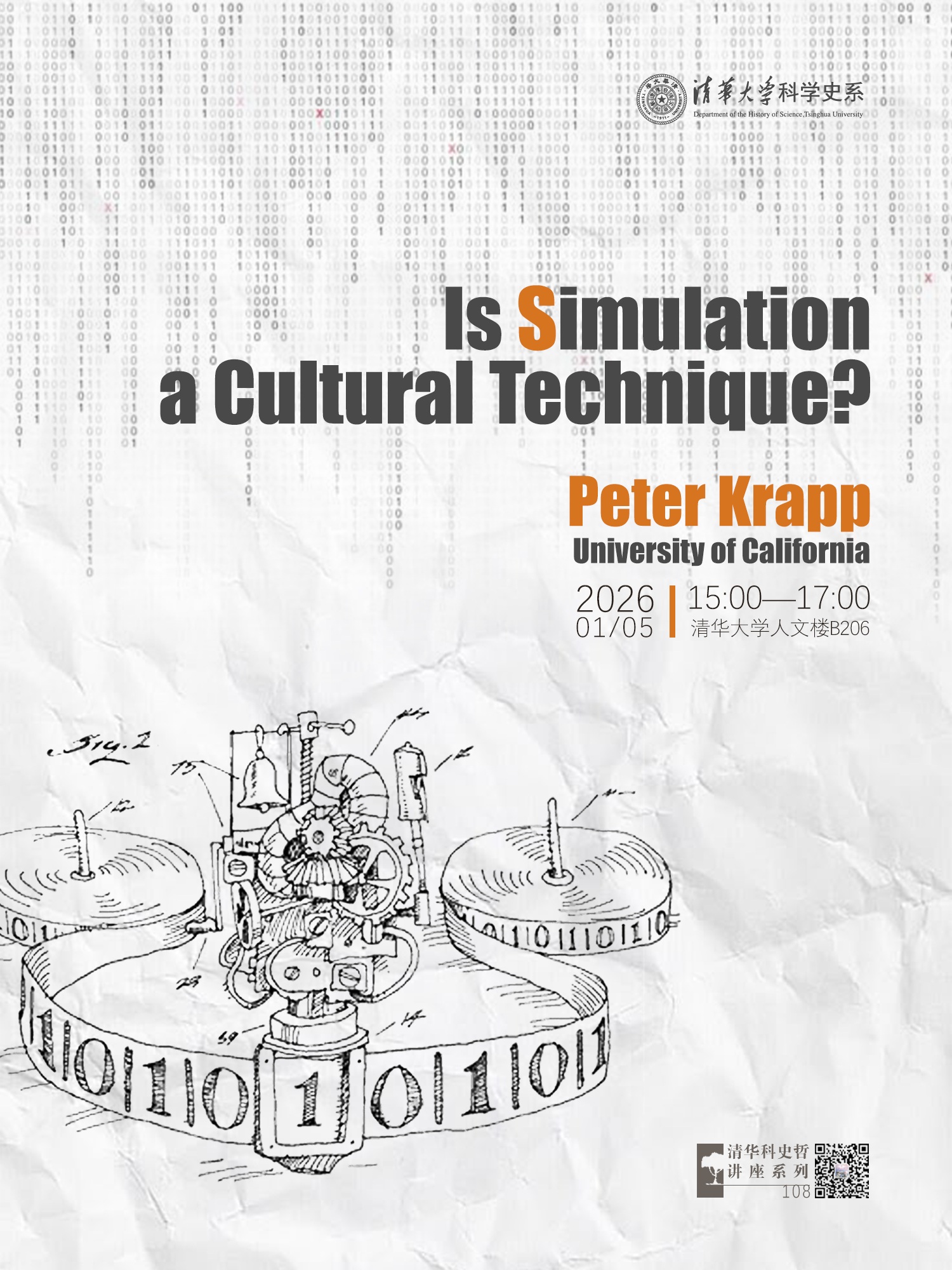
时间:2026年1月5日 15:00—17:00
地点:清华大学人文楼B206
主题:Is Simulation a Cultural Technique?
主讲人:Peter Krapp(University of California)
对谈人:吴璟薇 (清华大学新闻与传播学院)
讲座简介:
It is an axiom of computing that a Turing machine ought to be able to run any program for any other computer that is likewise a Turing machine; in other words, computers can impersonate each other. This not only lays certain theoretical foundations for computing, it also holds a promise for digital heritage, as new machines can simulate older ones. Thus, simulation has important implications for archives, museums, and the preservation of digital culture. Since the 1950s, scholars foresaw that once digital computing became fast enough to support more complex operations, it would furnish “simulation for vividness” in models that would strike observers as more clear and convincing, “simulation for deduction and exploration” that would make questions tractable or help explore them in new dimensions, and by the same token also provide for “simulation as archive,” whereby models store the collected knowledge of an entire discipline. This assemblage of a growing number of interdisciplinary contacts supports a model that would then itself be both archive and computer.
主讲人简介:
Peter Krapp is Professor of Film & Media Studies at the University of California, Irvine, and affiliated with the Departments of Music (Claire Trevor School of the Arts) and of Informatics (Donald Bren School of Information and Computer Science). Among his books are Deja Vu: Aberrations of Cultural Memory (2004), and Noise Channels: Glitch and Error in Digital Culture (2011), both with the University of Minnesota Press, and most recently Computing Legacies: Digital Cultures of Simulation (MIT Press 2024).