

Time: July 8, 2026, 19:00—20:30
Venue: Room B206, Humanities Building, Tsinghua University
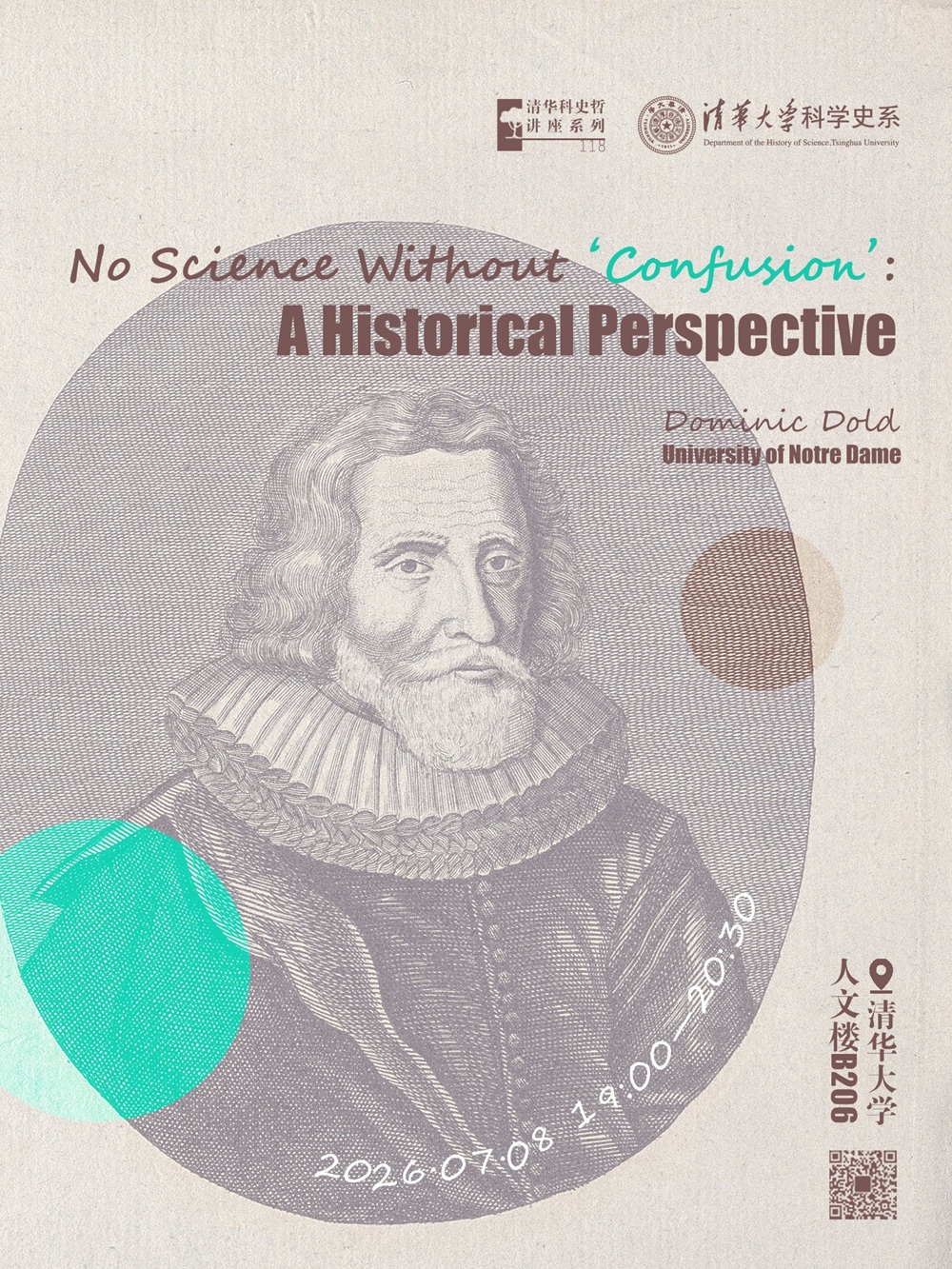
Topic:No Science Without ‘Confusion’: A Historical Perspective
Speaker:Dominic Dold (University of Notre Dame)
Lecture Abstract:
Cogent argumentation and gapless proofs built on precise definitions: these ideals are rarely realised by actual science. But some branches of science come close, branches (such as highly mathematised physics) that, it turns out, are about the most ‘fundamental’ structures of ‘reality’, such as space, time, and matter. ‘Distinctness’ (exactness, precision, and determinacy in definitions) therefore appears to be a mark of latching onto the grounds of ‘reality’, seemingly vindicating Descartes’s admonition to build knowledge on ‘clear and distinct perception’. Through three historical snapshots, this talk will offer a counter-narrative, suggesting that the dark and murky – the ‘confused’ (confusum in Latin) – cannot be eliminated from science and forms its ground. The starting point will be Joachim Jungius (1587–1657), who, in his influential Logica Hamburgensis, draws a distinction between ‘confused’ and ‘distinct experience’, advocating the latter as the foundation of empirical science. It will be argued that the concept of ‘distinct experience’ was theoretically ill-defined yet able to serve as a (fictitious) motivation for Jungius’s own scientific practice (his research on minerals). This will lead to scholastic Aristotelianism, the foil against which Jungius developed his concept, and in particular to one of the most outstanding scholastic scientists, Albert the Great (c. 1200–1280), who will be shown to have a sophisticated theoretical and practical account of building science on ‘confused’ cognition and achieving ‘distinctness’ in context-specific practice. From there, a jump to the general theory of relativity formulated by Albert Einstein (1879–1955) will show the continued relevance of ‘confused’ principles as the basis of scientific practice, along lines similar to what Albert the Great envisioned.
Speaker Profile:
Dominic Dold holds a PhD in philosophy from the Max Planck Institute for the History of Science and the TU Berlin (Germany) and a PhD in mathematics from the University of Cambridge (UK). His doctoral research in mathematics focussed on Einstein’s general theory of relativity, and his dissertation in philosophy on the connection between logic and natural philosophy (esp. zoology) in the works of the medieval scholastic Albert the Great (Albertus Magnus). Dominic has continued working on the history and philosophy of science, medieval philosophy, and the philosophy of physics through postdoctoral research positions at the University of Notre Dame (USA) and Keio University (Japan).