
On June 11, 2026, the 116th lecture of the Tsinghua University Lecture Series on the History of Science and Philosophy was held in Room B206 of the Humanities Building at Tsinghua University. The lecture, titled "Joseph Needham and Medicine: The History of an Interdisciplinary Puzzle," was delivered by Professor Guo Wenhua from the Institute of Science and Technology Studies at Yangming Jiaotong University, hosted by Associate Professor Shen Yubin from the Department of the History of Science at Tsinghua University, and accompanied by discussion by Professor Liu Bing from the Department of the History of Science at Tsinghua University. Before the lecture began, Professor Shen first introduced Professor Guo's academic experience and research background. Professor Guo received medical training in his early years and later obtained his PhD in STS from the Massachusetts Institute of Technology (MIT) in the United States. His research fields mainly cover public health, clinical trials, and the modernization and globalization of traditional medicine. He has long focused on the formation process of modern medicine in non-Western societies, and especially on the complex impacts generated when global medical knowledge, institutions and technologies entered East Asian societies.
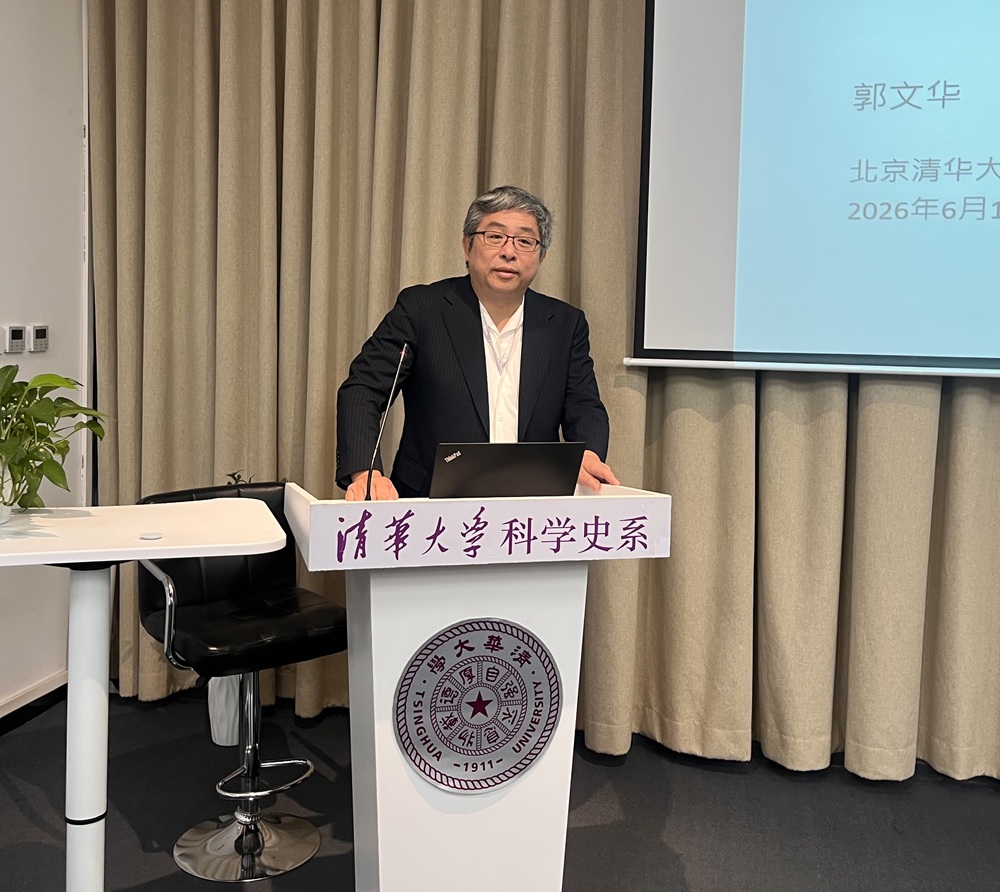
At the beginning of the lecture, Professor Guo Wenhua first shared his own academic experience to explain why medical history is a special and intractable subject in the history of science and STS. Professor Guo pointed out that, unlike many relatively closed specialized scientific fields, medicine encompasses multiple dimensions such as metaphysics, practice, communication, and art. Everyone is connected to illness, the body, aging, and death, making it difficult to simply distinguish who are the "insiders" or "outsiders" of medicine. Precisely because medicine is both a knowledge system, an institutional practice, and a life experience, medical history is often not fully encompassed by a single framework in the history of science and STS. On this basis, Professor Guo turned the discussion to Joseph Needham. He argued that revisiting Joseph Needham today is not simply to return to the traditional "Needham Question", but to ask: in Joseph Needham's massive project on the history of science and technology in China, why was medicine a particularly intractable subject? Professor Guo mentioned that in recent decades, Joseph Needham as a research subject has gradually faded from the academic center. Many still use materials from *Science and Civilisation in China*, yet few continue to discuss Joseph Needham himself and his academic project as a subject of inquiry. However, Joseph Needham was not merely a compiler of data; he was a rare polymathic thinker in the second half of the 20th century who spanned science, history, cultural diplomacy, and civilizational studies. Precisely in this sense, re-examining "Joseph Needham and Medicine" also serves as an entry point to reunderstand how interdisciplinary research is possible and why it is challenging.
Professor Guo then recounted the academic journey through which he encountered the Needham Question. During his studies at National Tsing Hua University in Taiwan, he was influenced by teachers such as Ho Peng-yoke and Yang Tsui-hua. When he first began to engage with the history of science, Joseph Needham's halo had already gradually faded; yet it was precisely during this period that the Needham Question was transformed into more complex issues concerning knowledge construction, historical interpretation, and the boundaries of scientific concepts. Furthermore, Professor Guo reviewed Shigeru Nakayama's critical analysis of Joseph Needham since the 1990s. He pointed out that Shigeru Nakayama was not content with confining the Needham Question to the realm of the history of science within East Asia, but instead sought to elevate it to a more general issue of knowledge and power.
Before moving on to the medical questions, Professor Guo raised a "Needham Puzzle" regarding medicine: Joseph Needham himself had a background in biochemistry and medicine, so logically, the medical volume of *The Science and Civilisation in China* should have been completed relatively early. However, the opposite is true: the medical volume was not only published quite late but also had a very small scale. This indicates that medicine was not the easiest part of Needham's plan to handle; on the contrary, it was one of the fields that were the most difficult to integrate into his overall narrative. Professor Guo emphasized that the problem does not lie in Needham's neglect of medicine. On the contrary, Needham and Lu Ganzhen had paid attention to Chinese medicine very early, and as early as around 1939, they already had relevant materials and made attempts to write about it. The real question is why these fragmentary observations and materials have always been difficult to organize into a complete argument.
Teacher Guo further introduced Christopher Cullen's archaeological study on the compilation process of the medical volume of *Science and Civilisation in China*. When the medical volume was published, Cullen pointed out that Joseph Needham had indeed accumulated a large amount of medical-related texts in his early years, but these materials were later deemed to need updating, rewriting and expansion, hence their delayed publication. In other words, the difficulty in compiling the medical volume stemmed not only from a lack of materials, nor from Joseph Needham's declining energy in his later years, but from the fact that medicine could hardly be fitted into his original framework of the history of science.
In the final part of the lecture, Professor Guo also discussed the relationship between alchemy, ingesting stones, health preservation, and traditional Chinese medicine (TCM). He pointed out that if we examine Joseph Needham's approach carefully, we will find that he did not simply exclude alchemy, ingesting stones, and health preservation from medicine. On the contrary, these contents show that Needham's understanding of the scope of "medicine" was more open than the modern disciplinary classification. Needham had a long-term interest in Taoism, immortality, health preservation, and alchemy, and these interests were intertwined with his understanding of Chinese medicine. This also explains why Needham encountered great difficulties in writing the volume on medicine: on the one hand, he encountered a large amount of material related to treatment, the body, and life; on the other hand, not all of this material could be easily assimilated by modern medicine, pharmacology, or clinical knowledge. Subsequently, Needham turned to dealing with content such as alchemy that he was more familiar with and that could be more easily connected to the narrative of the history of science. In other words, the relationship between alchemy and medicine is not a peripheral issue, but one of the key clues revealing Needham's medical puzzle.
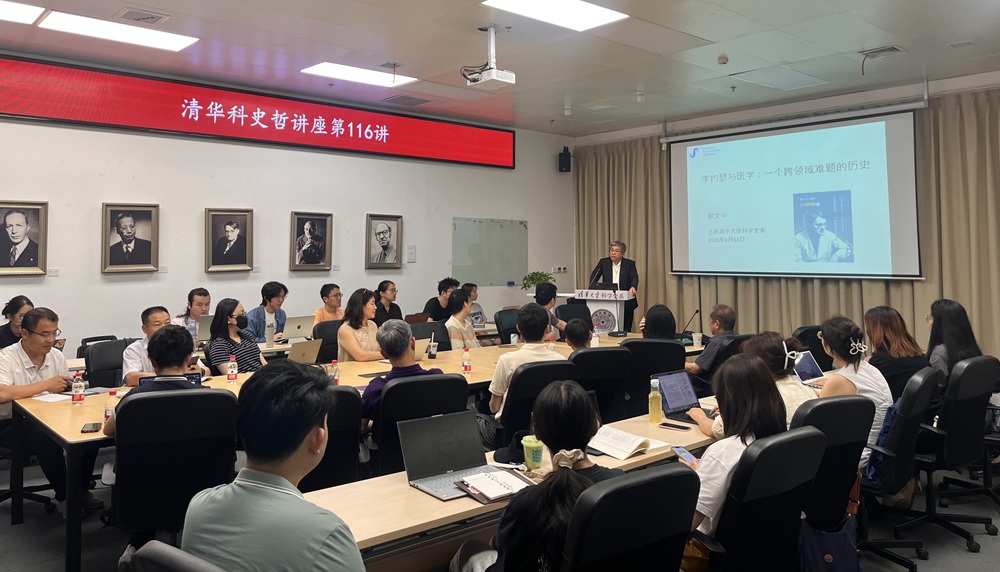
After the lecture, Professor Liu Bing commented on the lecture based on his personal contacts and interactions with scholars such as Joseph Needham and Nathan Sivin, and held a dialogue with Professor Guo around Joseph Needham Studies, the boundaries of medical history and the complexity of the concept of traditional Chinese medicine (TCM). Professor Liu pointed out that medical issues may be more difficult to be incorporated into a single framework than other scientific and technological issues, because "what is medicine" and "what is TCM" are unclear in themselves. TCM itself includes different traditions, and issues such as ethnic medicine, local medicine, Taoist medicine, and acupuncture anesthesia further expand the boundaries of medicine. The audience also asked questions about the future of TCM and Western medicine, the translation between TCM and Western medicine terms, China's policies of "learning from the West and learning from the East" and the establishment of the China Academy of Traditional Chinese Medicine in the 1950s. Professor Guo and Professor Liu responded to these questions. Finally, the lecture came to a successful end with warm applause.
Written by: Wen Zhanhong
Reviewed by: Sun Chengsheng