

On June 5, 2026, the 115th lecture of the Tsinghua University Lecture Series on the History and Philosophy of Science and Technology was successfully held. Titled "Commerce and the Sublime: Popular Astronomy Lectures in Nineteenth-Century Britain", the lecture was delivered by Associate Professor Huang Xiangfu from the School of History, Nankai University, and hosted by Associate Professor Shen Yubin. The lecture centered on Professor Huang's new book Commercial and Sublime: Popular Astronomy Lectures in Britain, 1780–1860. Published by the University of Pittsburgh Press in early 2026, the book is based on his doctoral dissertation completed in 2015 and revised over several years, offering a systematic investigation of the history of popular astronomy lectures in Britain from the late 18th century to the mid-19th century.
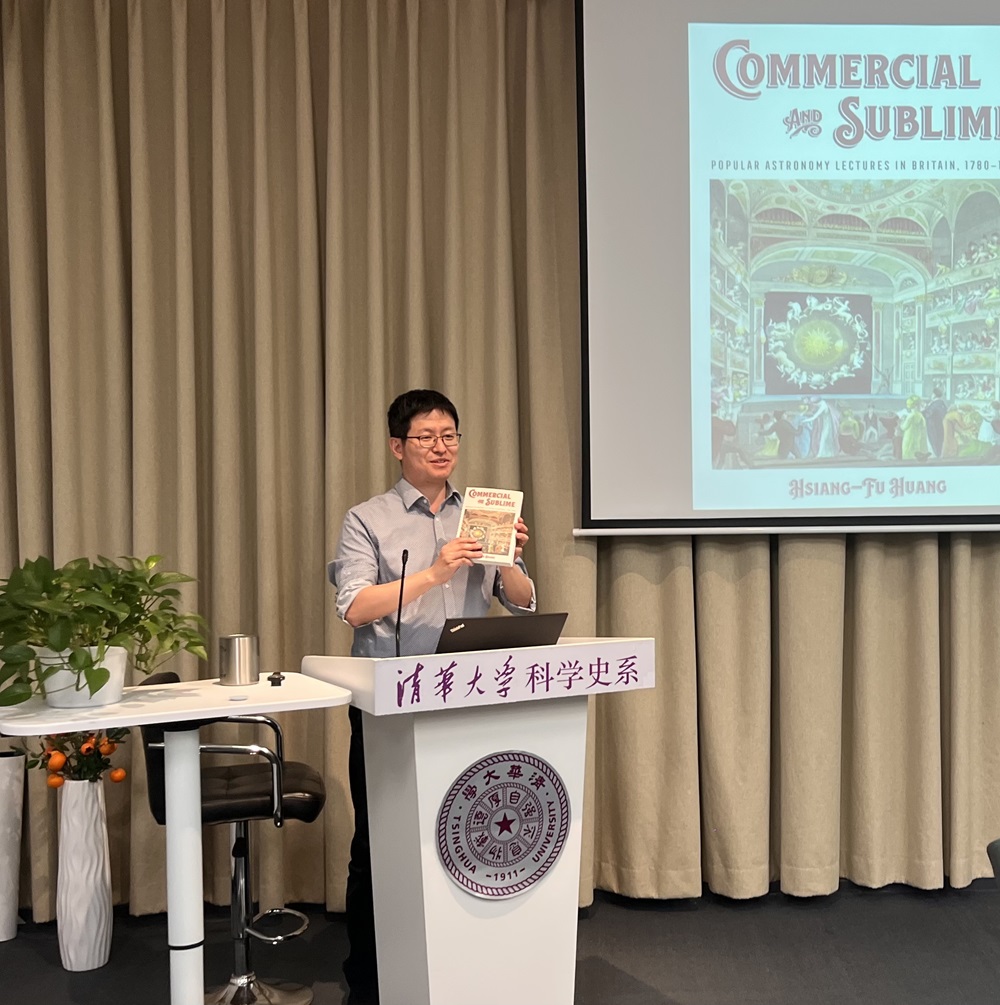
Teacher Huang Xiangfu first pointed out that popular astronomy lectures in modern Britain had two core characteristics: first, a distinct commercial nature, and second, the continuous shaping of the feeling of "sublimity". Since the 18th century, public lectures on natural philosophy had been quite popular in Britain. Such lectures usually took the form of charging fees and were open to the urban upper-class public, gentlemen and ladies, as well as audiences with a certain level of education, thus possessing an obvious market attribute from the very beginning. At the same time, experimental instruments and visual demonstrations were also important components of natural philosophy lectures. Through experimental displays, instrument operations and on-site explanations, knowledge of natural philosophy was organized into a public cultural activity that combined education, appreciation and social interaction. Popular astronomy lectures in 19th-century Britain developed gradually on the basis of this tradition and formed a relatively independent form of lectures and performances.
In this historical process, the Walker family played an important role. Adam Walker, the founder of the family, was engaged in public lectures on natural philosophy for a long time, and his descendants William Walker and Deane Franklin Walker inherited and developed this cause. They not only continued the business model of natural philosophy lectures but also constantly improved demonstration devices and stage effects. Among them, the Transparent Orrery was one of the visual aids highlighted by Teacher Huang. This device combined optical and mechanical technologies and simulated the operation of various planets in the solar system through a complex gear system. Initially, it had the nature of aristocratic collections and mechanical toys, used to display exquisite mechanical craftsmanship; however, people soon found that it also had strong teaching and demonstration functions. With the help of such devices, the abstract planetary motions, cosmic structures and astronomical phenomena could be presented to the audience in the form of images, light and shadow, and mechanical movements, thus making them easier to enter the public's understanding and imagination.
A notable change in the popular astronomy lectures in 19th-century Britain was the increasingly close connection they formed with theatre culture. Many astronomy lectures were no longer primarily held in schools or academic institutions, but instead moved into urban theatrical spaces such as London's West End. Lecturers not only explained astronomical knowledge, but also used lighting, stage sets, music, images and mechanical devices to create dramatic effects, making popular astronomy lectures increasingly close to stage performances. To attract audiences, lecturers also promptly used the latest astronomical discoveries as promotional selling points. For example, the debate surrounding "Vulcan" in the mid-19th century attracted widespread attention. At that time, some astronomers believed that there might be an undiscovered planet within Mercury's orbit to explain the anomalous phenomena of Mercury's orbit. Although this claim was later proven unfounded, it was a hot topic of public concern at the time. Popular astronomy lecturers quickly incorporated this so-called "new discovery" into their program content and promoted it through posters and advertisements to enhance the appeal of their performances.
Teacher Huang also focused on discussing the religious elements in astronomy lectures. In 19th-century Britain, popular astronomy was closely connected with natural theology. Natural theology held that by observing the order and complexity of nature, people could perceive the wisdom and existence of God. The most prominent representative of this school of thought was William Paley. Paley put forward the famous watchmaker analogy: if a watch were found in a wilderness, one would not assume it had come into being by chance, but would infer the existence of a designer behind it; similarly, the universe, being so complex and intricate, was regarded as evidence of the existence of a Creator. Against this ideological backdrop, astronomy became an important tool for demonstrating divine order. Many speakers frequently quoted verses from the Bible and interspersed musical performances to enhance the audience's awe and awe when confronted with the universe. The so-called "sublime" refers precisely to the emotional experience a person has when facing an object that is infinite, vast, mysterious, and beyond their comprehension, and the universe is undoubtedly one of the most suitable objects to evoke this feeling of sublimity.
Professor Huang further pointed out that the two major characteristics of popular astronomy in 19th-century Britain also had a profound impact on contemporary science communication, especially the expression methods of contemporary astronomy popularization. Taking the British astronomical documentary *Wonders of the Universe* as an example, the program extensively uses spectacular natural landscapes, grand music and philosophical monologues, constantly emphasizing the connection between humanity and the universe. Although this narrative method no longer appeals to God, it still highlights the mystery, grandeur and transcendence of the universe. In other words, although contemporary astronomy popularization has broken away from the religious framework of 19th-century natural theology, the emotional effects it pursues—wonder, awe and sublimity—show an obvious continuity with the popular astronomy lectures of the 19th century. This also helps us understand how modern science became a public culture.
After the lecture, the faculty and students present held discussions on topics such as the market size of the popular astronomy lectures, the relationship between the college's science and popular science popularization, and the tension between commercial profit-seeking and lofty narratives. Regarding the difficulty of accurately quantifying the market size of astronomy lectures, Professor Huang pointed out that judgments can be made through indirect materials such as lecture advertisements, ticket prices, theater information, newspaper reports, and the activity trajectories of speakers. Concerning how astronomy can move from college knowledge to popular entertainment, Professor Huang believes that modern college science and commercial science popularization are not simply a sequential relationship but have developed synchronously to a large extent. The high mathematical threshold of Newtonian mechanics made experimental demonstrations and visual explanations important paths for popular communication; astronomy, on the other hand, gradually separated from comprehensive natural philosophy lectures and became commercialized by virtue of unique large-scale demonstration devices and strong visual effects. Addressing the question of whether commercial profit-seeking and lofty narratives are mutually contradictory, Professor Huang holds that the two are more of a complementary relationship: commercialization is the realistic mechanism to sustain the operation of performances, while lofty discourse is an important cultural resource to attract and expand the audience.
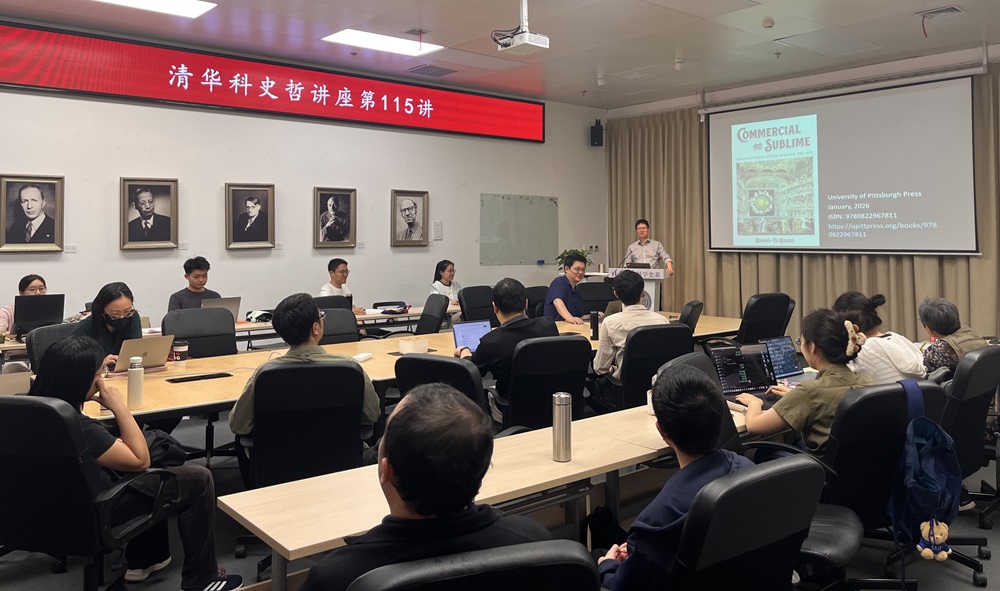
This lecture is rich in content and offers a novel perspective. Taking the popular astronomy lectures in 19th-century Britain as a case study, Professor Huang Xiangfu demonstrates how scientific knowledge moved out of professional institutions and into theaters, lecture halls, and urban public spaces. He also reveals how scientific communication interweaved with market mechanisms, visual devices, religious emotions, and popular culture. The lecture not only helps us understand the public communication of modern astronomy but also provides important inspiration for reflecting on how scientific knowledge becomes a public culture.
Written by Liu Xiaotong
Reviewed by: Shen Yubin