

On May 18, 2026, the 114th Tsinghua Colloquium on the History and Philosophy of Science and Technology was successfully held. The theme of this lecture was "Mathematics, History and Philosophy: A Unified Framework", and the speaker was Professor Ji Lizhen from the Department of Mathematics, University of Michigan, USA.
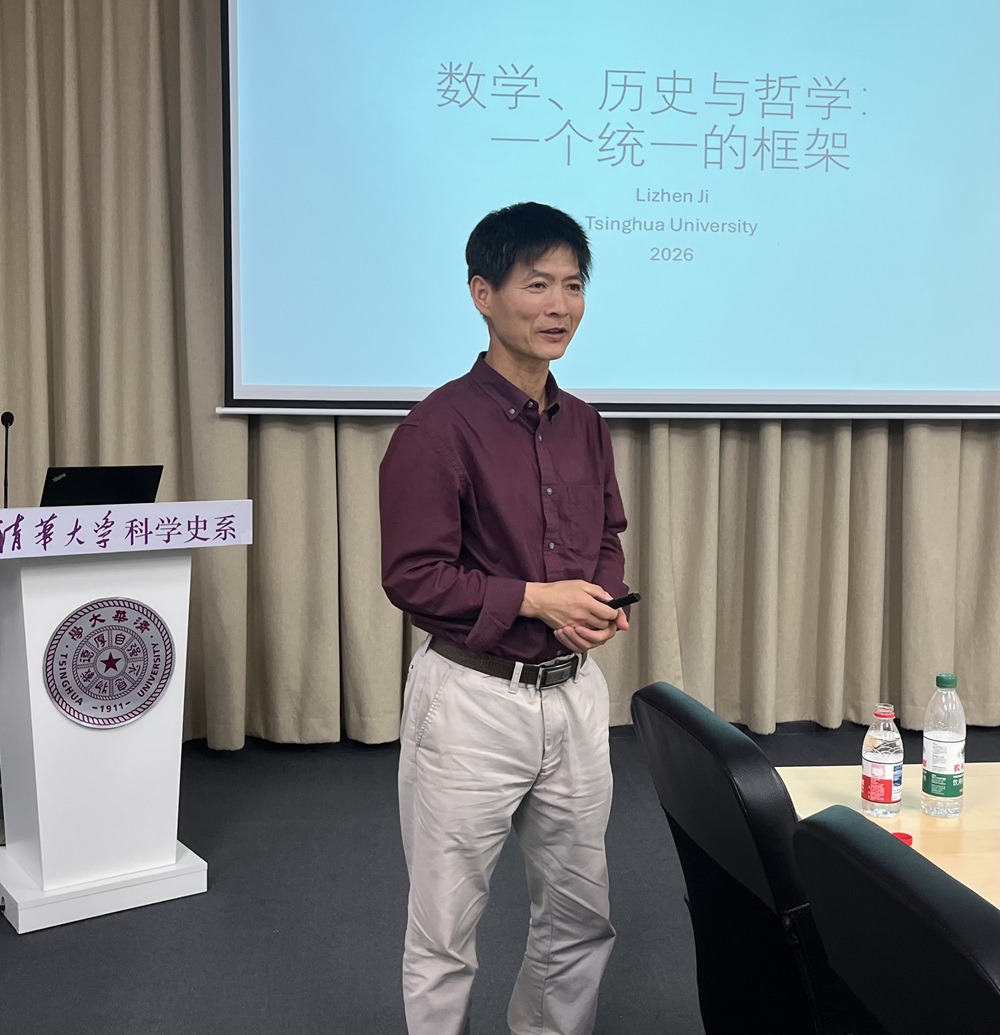
In this lecture, Professor Ji puts forward that if we can clearly understand the essence of mathematical changes from a philosophical perspective, it will be relatively easy to find valuable questions in the history of mathematics. He will outline a dynamic and unified framework for the development of mathematics and explain how to use this framework to identify the key turning points in mathematical development. These viewpoints will be illustrated through the history of non-Euclidean geometry and its influence.
At the beginning of the lecture, Professor Ji put forward a dichotomy: the static understanding of mathematical problems and the dynamic framework for understanding mathematics. Mathematics is not a static collection of truths but a complex system that grows dynamically. Inspired by Karl Popper's viewpoint that "knowledge growth is the core of scientific research," Professor Ji pointed out that understanding mathematics means grasping how it achieves leaps in scale and depth through specific mechanisms amid changes. Next, Professor Ji talked about "paradigm shift" and "incommensurability of theories" proposed by Thomas Kuhn in *The Structure of Scientific Revolutions*, two concepts that are common in physics or astronomy. Einstein's theory of relativity changed our fundamental definition of time and space, replacing Newton's absolute view of time and space in a sense. However, in the field of mathematics, this kind of classical theory is completely invalid. Professor Ji emphasized that any result proven in mathematics is always correct. There is no such thing in mathematics as Kuhn's claim that "theories before and after a revolution cannot understand each other." The emergence of non-Euclidean geometry did not prove that Euclidean geometry was wrong. Professor Ji shared his insights from reading *The Dice Man*. The revolution of quantum mechanics against classical mechanics was a complete subversion, but in the history of mathematics, he could not find any case similar to the "quantum revolution" that completely destroyed the previous system. On the contrary, Euclidean geometry remained valid in the era of non-Euclidean geometry, which is the best evidence of "advancement" rather than "replacement." It should also be noted that the growth of mathematics is also non-linear.
To explore how mathematical knowledge grows non-linearly while retaining eternal truth, Professor Ji proposed a growth model driven by three major macro-mechanisms:
1. Extraction: Forging from the Ashes of Failure The progress of theoretical mathematics often stems from a profound summary of past experiences. The most typical example is Évariste Galois. Amid countless geniuses who tried in vain to solve equations of degree higher than five and hit dead ends, Galois extracted the highly abstract concept of "group" from these failed attempts. He discovered that the solvability of an equation depends on a certain symmetry of its roots. This extraction from concrete experience to abstract logic completely reshaped the landscape of modern algebra.
2. Elevation: From the Unique Truth to the Special Case Elevation means placing an existing theory in a more general and inclusive context. Regarding non-Euclidean geometry, a common even standard narrative traces its development from Gauss to Einstein's general relativity, but this account is incomplete and misleading. In fact, this was a great "elevation". In 1854, the young Riemann delivered a lecture to qualify as a lecturer, preparing three topics, and Gauss chose the hardest third one—the foundation of geometry. In his lecture, Riemann broke out of the Euclidean framework and introduced the concept of curvature. Through Klein's "Erlangen Program", mathematicians realized that Euclidean geometry is merely a special case where the curvature is zero. Non-Euclidean geometry did not destroy Euclidean geometry; instead, it elevated it: it led mathematics from a single logic to diversity, and ultimately achieved integration through symmetry and group invariants.
3. Fusion: A Marvel of Integration Across Disciplinary Islands Fusion refers to the deep coupling between different fields. Professor Ji specifically mentioned Poincaré. He integrated the seemingly unrelated "complex analysis" and "non-Euclidean geometry" to create automorphic functions. Such logical collisions between different domains often produce mathematical marvels. Just as Mr. Shiing-Shen Chern made contributions to the Gauss-Bonnet Theorem, he revealed the integration mechanism between local geometric properties and overall topological structures at the micro level.
In addition to the three macro mechanisms, Professor Ji also believes that the development of mathematics also involves five aspects of micro outputs: problems and conjectures, definitions, theorems, algorithms, and proofs. Furthermore, facing the massive explosion of mathematical materials since the 20th century, Professor Ji holds that Sima Qian's *Records of the Grand Historian* provides a perfect model for dealing with the complex history of science. Sima Qian put forward the idea of "comprehending the changes of the past and the present to form a unique viewpoint", and his five styles can be perfectly mapped to the construction of the history of mathematics: 1) Annals: Recording the key milestones in the history of mathematics development and the decision-making paths of top masters. 2) Tables: Used to establish interdisciplinary knowledge. Through a horizontal timeline, it shows the interactive connections between different mathematical branches (such as algebra and number theory) at specific moments. 3) Treatises: Specifically discussing the institutional/systematic evolution of special topics such as axiomatic systems and the evolution of abstraction. 4) Hereditary Houses/Biographies: Recording the contributions of mathematical centers (such as the Paris School), important schools, and core mathematicians. The task of mathematical historians is not to repeat history, but to explain: why did certain mathematical branches undergo transitions at specific moments?
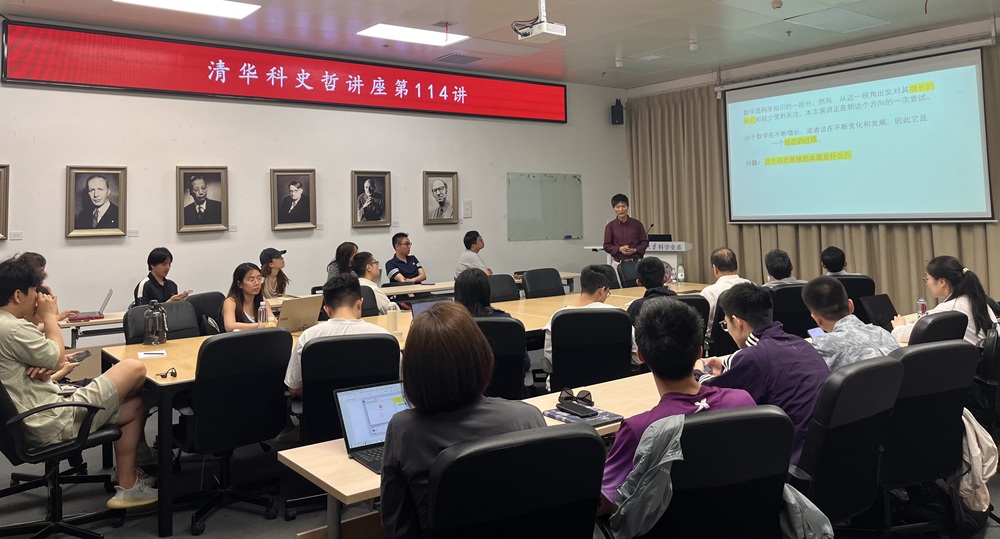
History without philosophy is blind, and philosophy without history is empty." At the end of the lecture, Teacher Ji reiterated that if the core of mathematics itself is stripped away, both the history of mathematics and the philosophy of mathematics will be reduced to marginal trivialities. During the free discussion session, the participants had a collision of ideas regarding the objectivity of mathematics, historiographical methodology and literary metaphors. It is undeniable that mathematics, history and philosophy form an interdependent "trinity".