

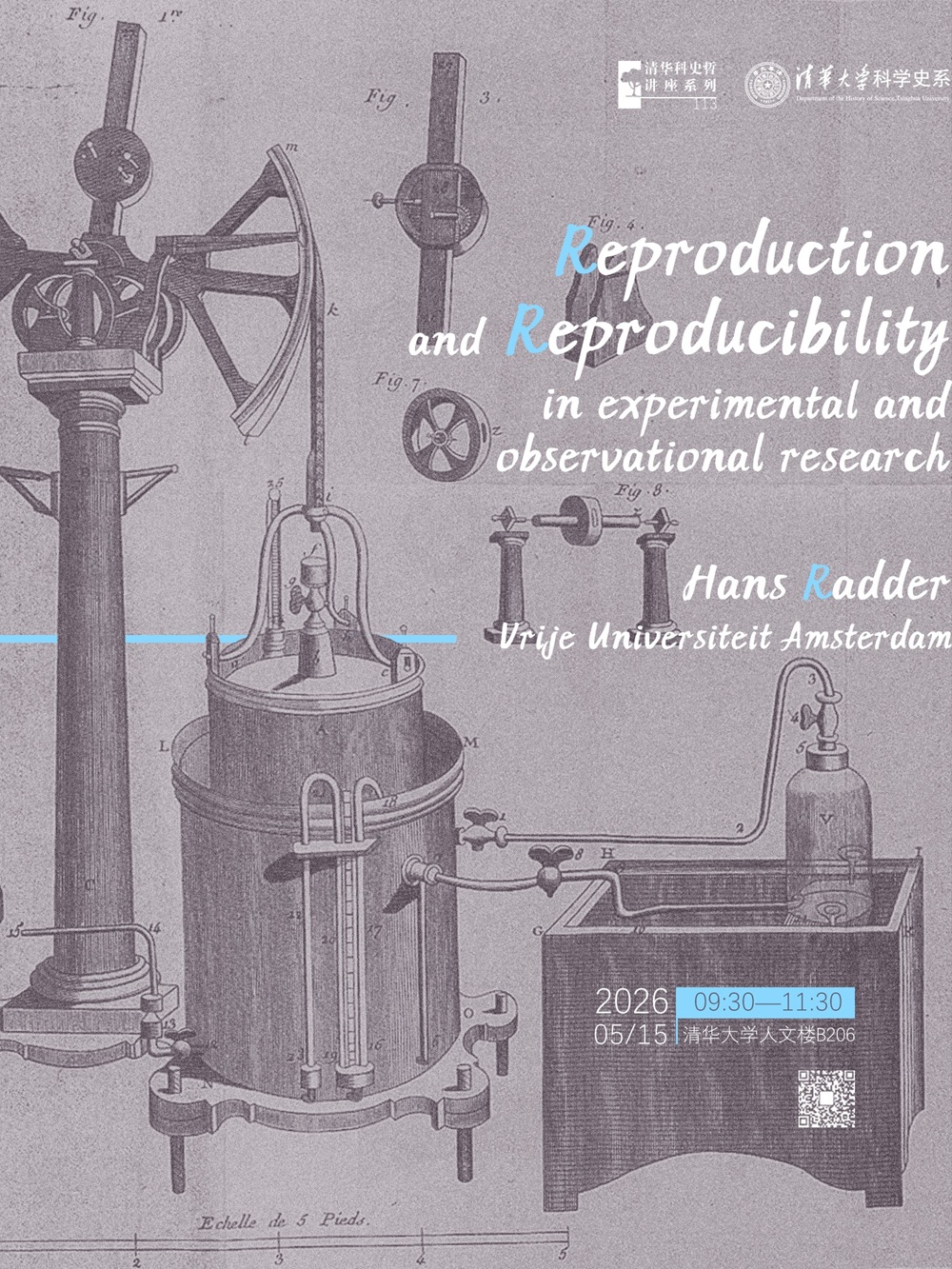
Time: 09:30—11:30, May 15, 2026
Venue: Room B206, Humanities Building, Tsinghua University
Topic: Reproduction and reproducibility in experimental and observational research
Speaker: Hans Radder (Vrije Universiteit Amsterdam)
Abstract:
(a) I sketch a general theory of reproduction and reproducibility in the sciences, including:
(i) some historical observations concerning the notions of reproduction and reproducibility
(ii) an application of this theory to the current debate on the reproducibility crisis
(iii) an extension of the theory by including the role of reproducibility in psychology
(b) Reproducibility can, and should be, related to the aims of science
From a societal perspective, science has, at least, these two related aims:
- Generating knowledge
- Contributing to the development of useful technologies
The aims are related:
- technology is often involved in generating knowledge;
- developing technologies requires knowledge, often scientific knowledge.
(c) Reproducibility and reproduction are related to these aims in the following way:
They function as criteria and tests of the intersubjective validity of knowledge claims
They function as criteria and tests of the stable working of technological artifacts or systems
(for instance, in patent applications, the invention should be reproducible by the peers of the inventor)
(d) Some points concerning the terminology and the focus of the presentation:
(i) In order not to forget the productive character of empirical and technological work, it is preferable to speak of reproducibility and reproduction, rather than replicability and replication.
(ii) Reproductions are actual repetitions (in the present or the past);
Reproducibility refers to the possibility of actual reproduction; that is, reproducibility claims are fallible, or even hypothetical.
(iii) The notions of reproducibility and reproduction are about experimental and observational practices, that is, about empirical procedures. ‘Reproducing an argument’ is a different topic.
For practical reasons and limited time, my discussion focuses on experimentation (but my conclusions are meant to apply to observation as well).
(iv) Finally, in this presentation, the focus will be on general arguments. They can be illustrated and supported by concrete experimental or observational practices, as evidenced in the literature on which this presentation is based.
Introduction of the speaker:
Hans Radder is professor emeritus and affiliated researcher in the Department of Philosophy at Vrije Universiteit Amsterdam. The subject of his teaching and research is the philosophy of science and technology, broadly conceived by substantially including socio-political and moral issues. Relevant themes in his work are: scientific observation and experimentation, the social and moral significance of science and technology, and the commercialization of science. His publications include the books The world observed/The world conceived (2006), The material realization of science: From Habermas to experimentation and referential realism (2012) and From commodification to the common good: Reconstructing science, technology, and society (2019).