

Time: April 27, 2026, 15:00—17:00
Venue: Room B206, Humanities Building, Tsinghua University
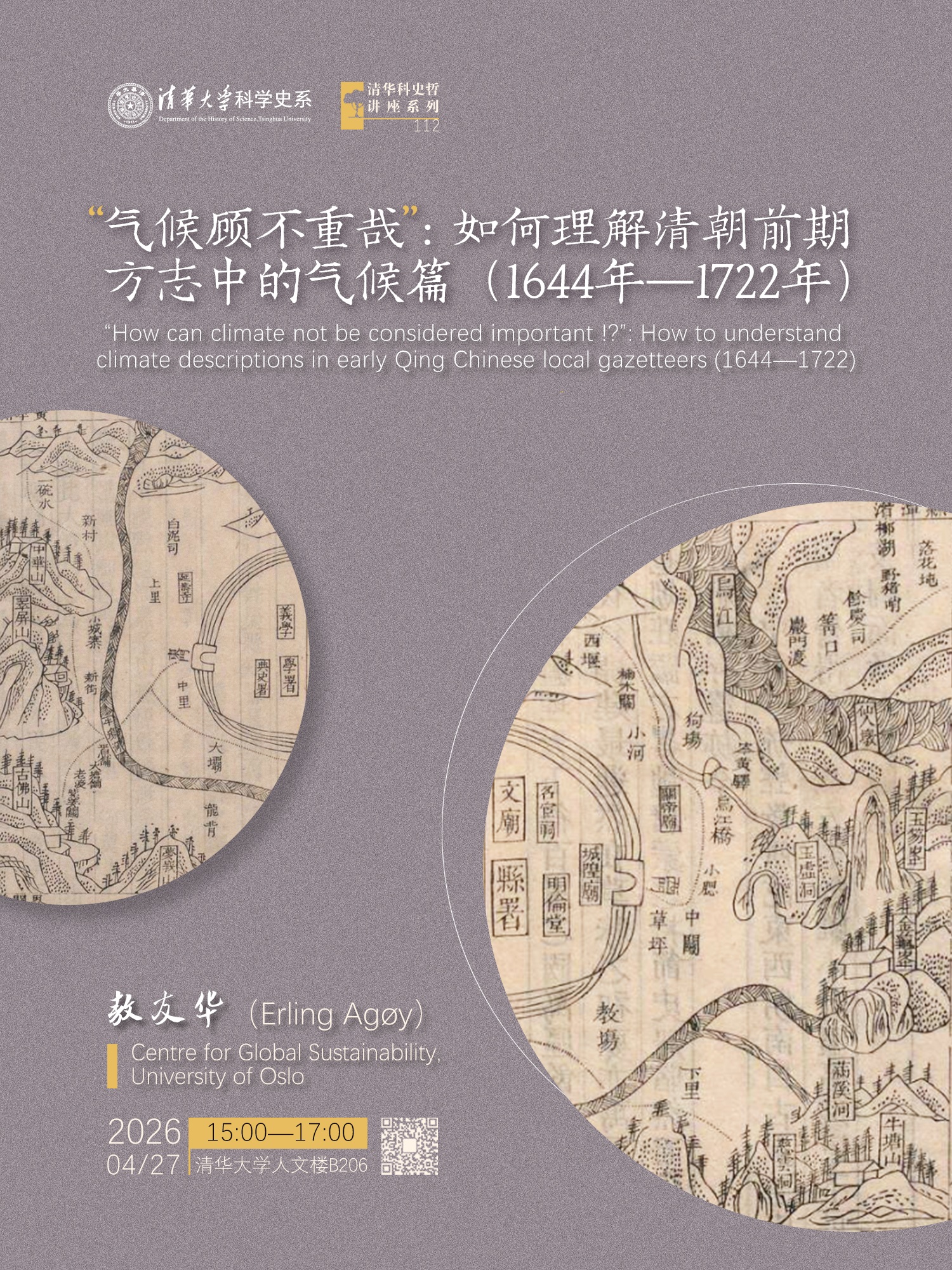
Topic: "Is Climate Neglected?": How to Understand the Climate Chapters in Local Chronicles in the Early Qing Dynasty (1644-1722)
Speaker: Youhua Ao, Erling Agøy (University of Oslo)
Lecture Abstract
Why were local climates described in late imperial China – and how? Local elites used gazetteers to carve out their place within China’s cultural space. Among their varied contents were essays on climate, found prominently in Fujian, Guangdong, Guangxi and Yunnan. This presentation argues that climate sections in early Qing-era gazetteers can be analysed from the perspective of early science. Taken together, they constitute a remarkable effort to understand local climates. The essays involve serious studies based on textual analysis, folk knowledge, observations and comparisons. They often demonstrate an acute understanding of how geographical features like mountains, the sea and altitude affect climates. Through these efforts, they made an important contribution to early modern understandings of local climates in China. These texts must at the same time be understood through their relation to local identity. They clearly tied climates to landscapes and customs: faced with outsiders’ stereotypes, South Chinese scholars wished to explain their local climates as different, yet liveable.
Speaker Profile
Ao Youhua (Erling Agøy), a doctoral graduate from the University of Oslo, has successively conducted postdoctoral research and given lectures at the University of Erlangen-Nuremberg in Germany, the University of Oslo in Norway, and the Joseph Needham Research Institute in the UK. Starting with the human climatic experience in the Little Ice Age in the Jiangnan region during the 17th century, his research focus has gradually shifted to the history of climatic thought in the Ming and Qing dynasties. His published works cover weather forecasting (agricultural divination), disaster prevention measures during the Little Ice Age, collective climatic memories, etc. His current research topics include climatic chapters in local chronicles, omens of wars, and the concept of dialects in local chronicles.