

On the afternoon of January 5, 2026, the 108th Tsinghua Lecture on History and Philosophy of Science, hosted by the Department of History of Science at Tsinghua University, had the honor of inviting Professor Peter Krapp from the Department of Film and Media Studies at the University of California, Irvine, to give a lecture entitled "Is Simulation a Cultural Technique?". Professor Krapp also holds a position in the Department of Music and Informatics. He has long been committed to researching memory, noise, and glitches in digital culture, and published his new book "Computing Legacies: Digital Cultures of Simulation" (MIT Press) in 2024. This lecture was chaired by Associate Professor Shen Yubin from the Department of History of Science at Tsinghua University, with Associate Professor Wu Jingwei from the School of Journalism and Communication at Tsinghua University serving as the commentator. The content of the lecture was largely based on the first chapter of "Computing Legacies". Instead of discussing from a purely theoretical or sociological perspective, Professor Krapp conducted an in-depth exploration of "Simulation" as a broad technical term and Cultural Technique, expounding on the central role of simulation in knowledge production, historical preservation, and future prediction.
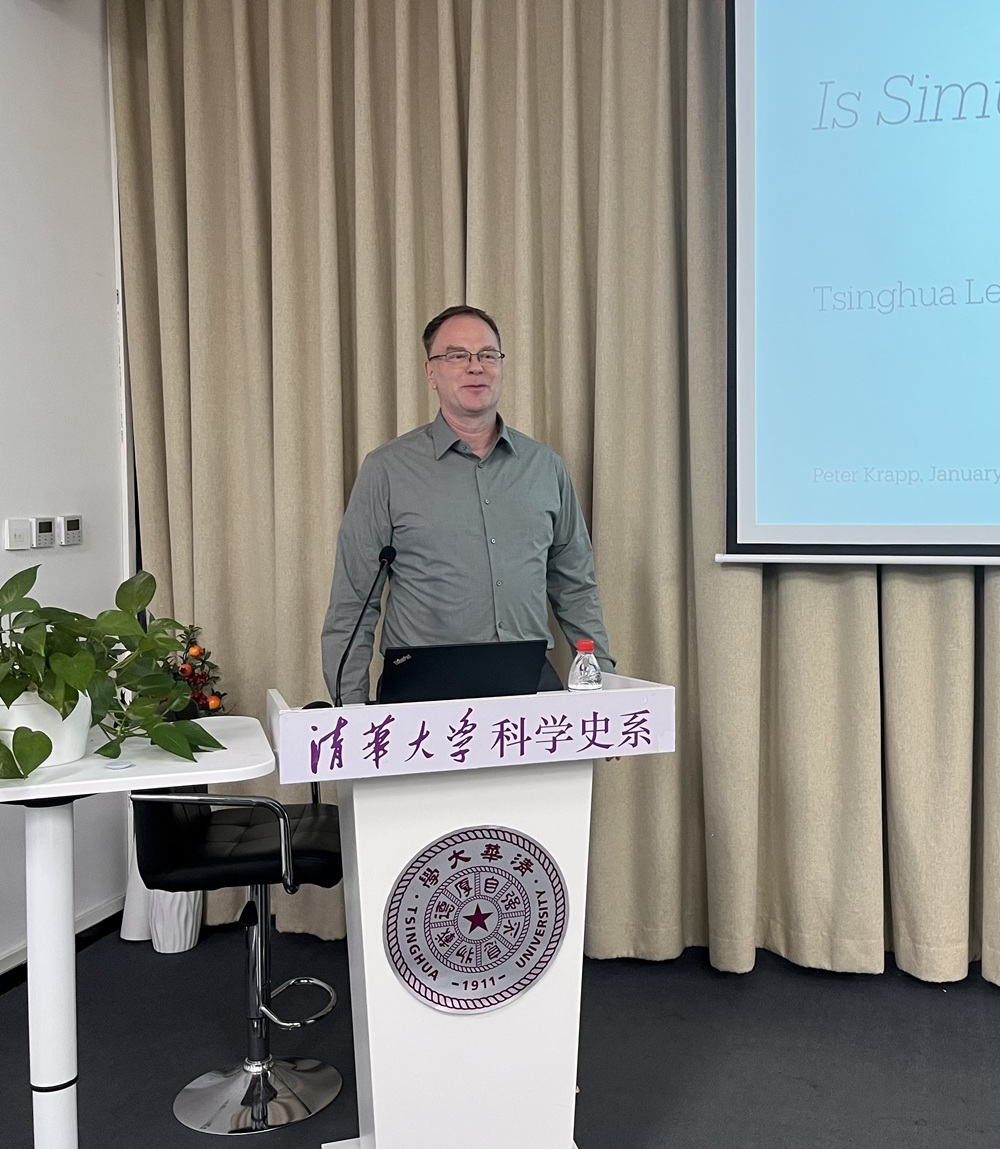
First, Professor Klapp elaborated on the core concept of "cultural technology" and used it as an entry point to break down the boundaries between culture and technology in traditional disciplinary divisions. He pointed out that not all technologies are cultural technologies; only those activities with symbolic functions (such as speaking, writing, reading, drawing, calculating, etc.) fall into this category. These technologies have an epistemic nature and can generate knowledge independently of specific applications. Professor Klapp believes that simulation should not be regarded merely as a means of replication or imitation, but rather as a symbolic cultural technology capable of generating new knowledge. In modern times, this technology has fostered a kind of "hypothetical literacy," which is the ability to explore theories and hypotheses through "what if" thought experiments. He specifically refuted the view advocated by figures like Elon Musk that "we are most likely in a simulation," considering it a misunderstanding of simulation technology. Instead, simulation should be seen as a core perspective for understanding digital culture and a fundamental assumption of Computing.
Then, Professor Klapp traced the development of analog technology and its applications in various fields through case studies in the history of computing technology. He mentioned the influence of Charles Babbage as a pioneer in computing, pointing out that statistics, game theory, and simulation have transformed the paradigm of scientific research. The lecture showcased the early flight simulator (Link Trainer), explaining how simulation trained pilots in a low-risk environment through mechanical feedback systems, which was an early successful form of mechanical simulation with a closed-loop feedback mechanism. Additionally, he drew on the history of code-breaking at Bletchley Park during World War II, noting that due to the need for frequency analysis of encrypted communications in the radio age, Simulation and Emulation existed even before the invention of digital computers.
Next, Professor Klapp distinguished between "simulation" and "emulation" and focused on discussing the role of emulation in the preservation of digital heritage. Simulation is usually a simplification of specific attributes in an abstract model, aiming to avoid future disasters or predict outcomes; while emulation aims to achieve equivalent results, that is, regardless of the internal state, the same input should produce the same output. With the rapid update and iteration of computer hardware, the cost of maintaining old machines (such as mainframes) is extremely high and difficult to achieve. As shown in the case of the Living Computer Museum in Seattle, once financial support is lost, it is difficult to maintain the physical collection. Therefore, software emulation (such as running old systems on modern devices) has become an important means to preserve digital culture, the history of software development, and understand the history of media. This enables historians and museums to use emulation technology to allow modern people to experience retro games or old computing environments.
Finally, Professor Klapp reflected on the limitations of models and the critical nature of input data. He quoted a famous saying: "All models are essentially wrong, but some are useful." He emphasized that whether it is weather forecasting, COVID-19 pandemic models, or non-destructive testing simulations of nuclear weapons, models rely on specific assumptions and input data. Input bias can lead to biases in output results (i.e., "garbage in, garbage out"), which is particularly evident when it comes to complex social behaviors (such as university management simulations or epidemic tracking). He pointed out that even laboratories with top supercomputers (such as the Lawrence Livermore National Laboratory) may face the embarrassment of irreproducibility in their simulation results. Therefore, understanding the cultural dimensions, historical context, and technical trade-offs behind simulations is crucial for critically engaging in digital culture.
After the lecture part, Associate Professor Wu Jingwei, the commentator, summarized Professor Klapp's lecture and had a lively discussion with the teachers and students present.
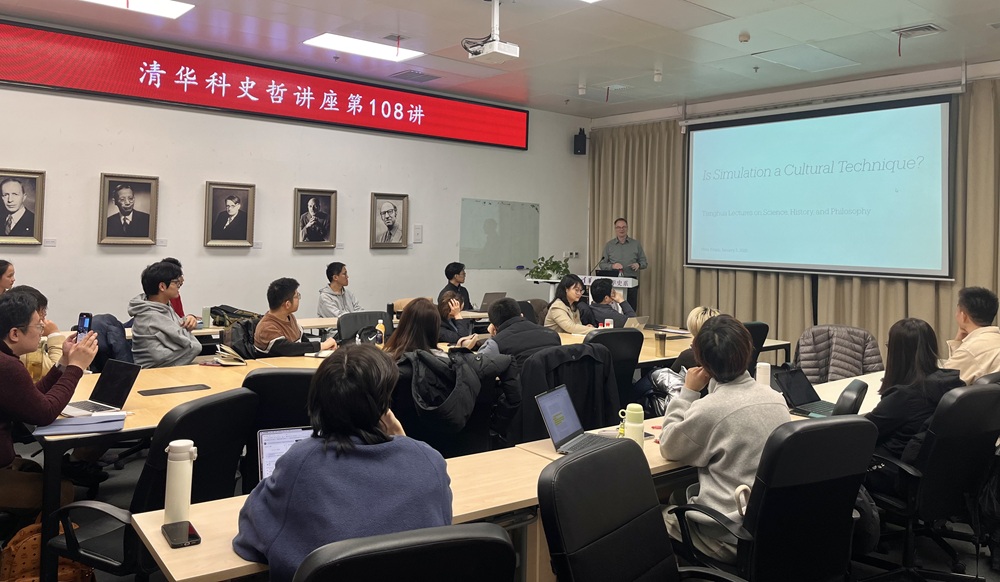
Associate Professor Wu Jingwei first summarized the importance of the concept of "cultural technology", pointing out that it is a bridge to understand the relationship between humans, nature and technology, and discussed with Professor Klapp the etymological and epistemological differences between "Calculating" and "Computing". She also mentioned that digital heritage is not only related to grand historical archives, but also closely linked to everyone's daily life records (such as personal data and social media traces). From the perspective of media studies, Professor Klapp further explained that simulation, as a cultural technology, has long been an important part of human digital culture.
During the Q&A session, someone raised a question about the non-neutrality of the relationship between inputs and outputs in the IPCC (Intergovernmental Panel on Climate Change) models, pointing out that scientists often overlook the cultural and political dimensions in the data processing process. Professor Clapp responded that cleaning the input data is more difficult and crucial than interpreting the output, and emphasized the necessity of introducing historical and interpretive perspectives in the fields of engineering and science. Another person shared research on the history of China's "Emulators" (often translated as "模拟" in Chinese) and discussed the ambiguity between "Simulation" ("模拟") and "Emulation" ("仿真") in the Chinese context. They then expressed concerns that War Gaming trivializes war and thus dissolves war responsibilities and ethics. In response, Professor Clapp noted that the history of war simulation predates computers, as sand table exercises and board games have long been used in military training. He acknowledged the close connection between technology and the military but also warned against overstating technological determinism. He recommended James Der Derian's research on international relations and simulation for further reference. Finally, the lecture concluded successfully with warm applause.
Written by: Yang Mingfan
Reviewed by: Shen Yubin