

On the morning of December 18, 2025, the Department of History of Science at Tsinghua University successfully held the 107th Tsinghua Lecture on History and Philosophy of Science in Room B206 of the Meng Minwei Humanities Building. Professor Hu Minghui from the Department of History at the University of California, Santa Cruz, gave a lecture titled "Rereading Kuhn's The Structure of Scientific Revolutions: Starting from Ian Hacking's Introduction". This lecture was chaired by Professor Sun Chengsheng from the Department of History of Science at Tsinghua University.
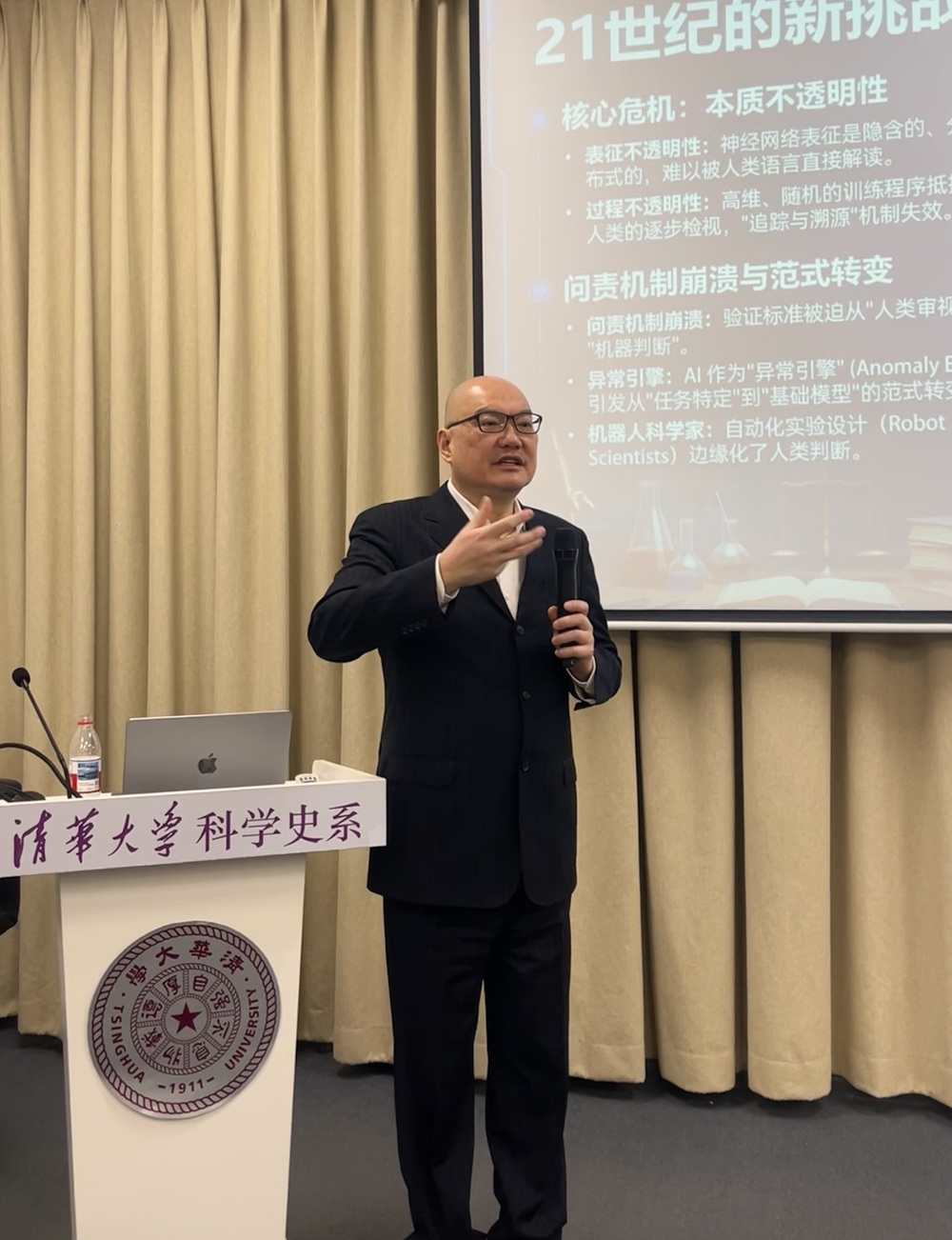
At the beginning of the lecture, Professor Hu used Ian Hacking's introduction to the 50th anniversary new edition of Thomas S. Kuhn's The Structure of Scientific Revolutions to guide the audience to think about why this classic work, written during the Cold War space race era, has endured and still has strong vitality in the age of artificial intelligence and big data. He pointed out that re-reading Kuhn is not only a review of the history of the philosophy of science, but also a rediscovery of the humanistic core of "science as a historical, linguistic, and communal practice," aiming to respond to the fundamental questioning of the form of human rationality in the algorithmic age.
Professor Hu first outlined the core structure of Kuhn's theory—the "paradigm" and the dynamic cycle of "normal science-anomaly-crisis-scientific revolution" driven by it. He specifically analyzed the controversial concept of "incommensurability," pointing out that it does not advocate irrationality, but reveals the deep-seated discontinuities between competing paradigms in terms of worldviews, evaluation criteria, and terminology systems, thereby challenging the old narrative that science is a linear accumulation of progress. Based on his grasp of Kuhn's ideas, Professor Hu systematically elaborated on three far-reaching paths of ideological response:
- Rational reconstruction: Represented by Imre Lakatos and Larry Laudan, while criticizing logical positivism, it attempts to salvage the rational continuity in scientific changes through concepts such as "research program" and "problem-solving rationality".
- Social construction: Represented by Andrew Pickering, Steven Shapin, and Actor-Network Theory (ANT), it regards science as a practical network of negotiations among laboratories, instruments, and social interests, emphasizing the productivity and constructiveness of knowledge.
- Historical epistemology: Represented by Lorraine Daston, Peter Galison, and Hans-Jörg Rheinberger, and jointly inspired by Thomas Kuhn and Michel Foucault, it turns to the research on the historical generativity of scientific objects themselves (such as the concept of "objectivity"), focusing on the co-evolution of concepts, instruments, and objects in the "experimental system".
The second half of the lecture focused on the new challenges of the 21st century. Professor Hu proposed that generative AI, as a new "anomaly engine", is triggering a paradigm shift from "task-specific" models to "foundation models". Its "essential opacity" (the opacity of representations and processes) has led to the collapse of traditional accountability mechanisms based on human scrutiny, forcing scientific verification standards to shift towards "machine judgment". In this context, he emphasized the need to develop a "hybrid epistemology", that is, to build a new knowledge production framework that combines human-machine collaboration, distributed accountability, and institutional "thick trust", and to maintain algorithmic transparency through cultural channels and shared standards.
Finally, Professor Hu summarized Kuhn's three major intellectual legacies (the historicist turn, community-centrism, and incommensurability) and their enduring influence. He specifically reflected on the "Needham Question" in the context of Chinese science history research, pointing out that the long-term stability exhibited by traditional knowledge systems such as Chinese astronomy precisely provides an alternative historical model different from the Western narrative of the "Scientific Revolution," prompting us to consider how political, social, and cultural factors interact with knowledge paradigms.
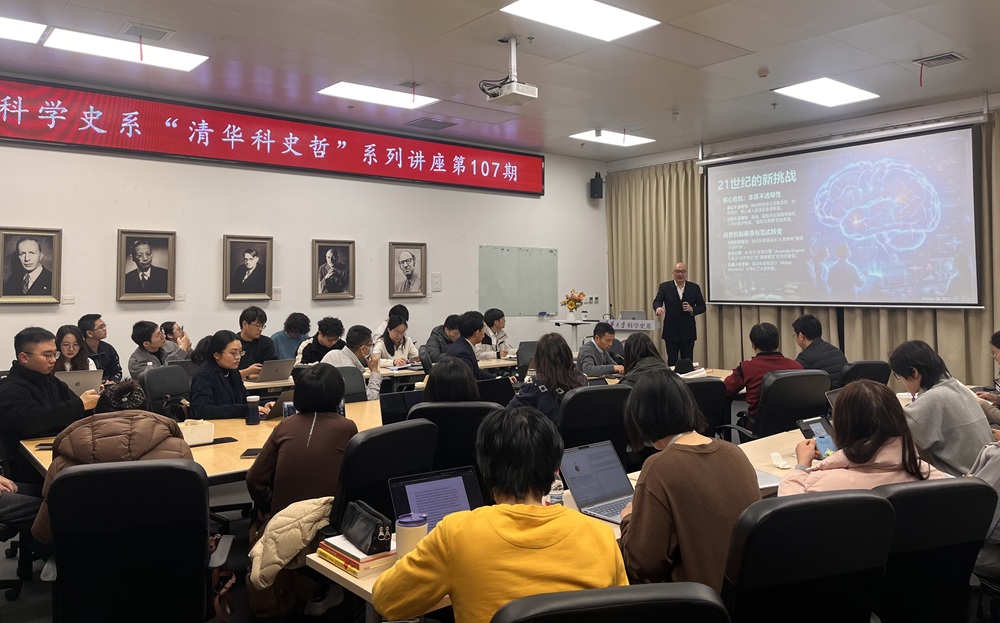
In the subsequent Q&A and discussion session, teachers and students on site had in-depth exchanges with Professor Hu on issues such as the scale of paradigms, the manifestation of incommensurability in interdisciplinary fields, the characteristics of scientific paradigm shifts in the AI era, the applicability of Kuhn's theory to the study of Chinese science and technology history, research methods of historical epistemology, and whether paradigm analysis is applicable to the humanities and social sciences. Combining specific research cases, Professor Hu gave detailed responses one by one, which further stimulated the audience's thinking on Kuhn's ideas and their contemporary value. The lecture ended successfully with warm applause.
Written by: Huang Xin
Reviewed by: Sun Chengsheng