

On the morning of December 9, 2025, the 106th Tsinghua Lecture on History, Philosophy and Science of Science was held in Room B206 of the Mengminwei Humanities Building. Professor Hu Minghui from the Department of History, University of California, Santa Cruz, gave a lecture entitled "Did Qing Dynasty Textual Research Have a Scientific Spirit? Centered on Dai Zhen's 'Kaogongji Tu'". This lecture was hosted by Professor Sun Chengsheng from the Department of History of Science.
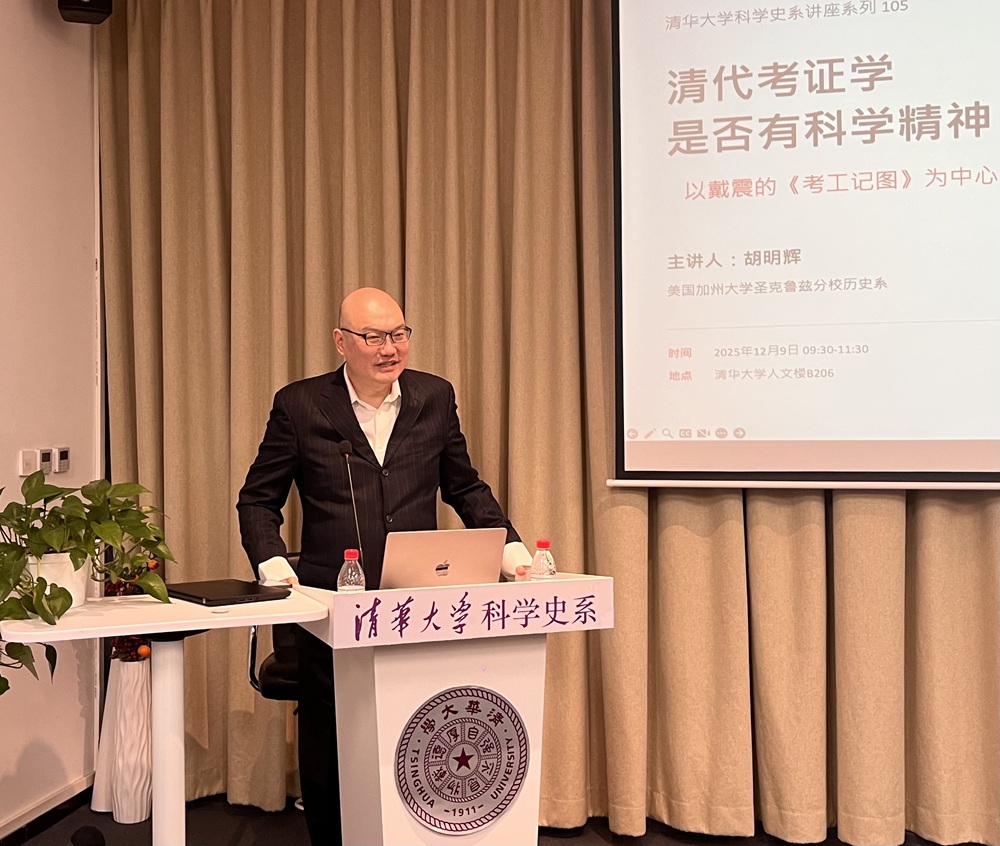
Professor Hu first reviewed Liang Qichao and Hu Shi's "discovery" of Dai Zhen in the early 20th century, especially the "scientific spirit" discourse framework established by Hu Shi in "The Philosophy of Dai Dongyuan", and pointed out their limitations. He then examined Dai Zhen and his academic achievements within the unique social economy and knowledge circulation network of the 18th century, providing a new perspective for us to re-understand Dai Zhen's thoughts and their modern significance.
Professor Hu pointed out that to understand Dai Zhen, one must delve into the historical context in which he lived. In the 18th-century Qing Empire, under the state-licensed salt monopoly system, the merchant class represented by Huizhou merchants accumulated enormous wealth, forming a complex network of commerce and power connecting the Jiangnan region with the imperial court in Beijing. This network was not only a channel for the circulation of goods and capital but also a path for the dissemination of knowledge and technology. Western scientific knowledge and precision instruments introduced by Jesuits, which were originally monopolized by the Qing court, such as Napier's bones, quadrants, as well as scientific works like *Elements* and *Illustrated Explanations of Extraordinary Instruments from the Far West*, flowed from the court to the elite class in Jiangnan through this network. Born into a Huizhou merchant family, Dai Zhen benefited from this unique material and cultural ecosystem, gaining access to and mastering these Western learning knowledge that far exceeded the intellectual scope of traditional Confucian scholars in his youth, laying a solid foundation for his later creation of a unique academic path.
Unlike Mei Wending, Jiang Yong, and others, who first laid a solid foundation in Confucian classics and then dabbled in Western learning out of interest, Dai Zhen's academic path was "prioritizing sciences over classics". In his early years, he immersed himself in fields of "studying things to attain knowledge" such as mathematics, astronomy, and mechanics. After mastering the most advanced scientific knowledge and skills of his time, it was only under the persuasion of his teachers and friends that he consciously applied these precise and systematic knowledge systems to the study of Confucian classics. This was not a simple academic shift but a profound revolution in the knowledge paradigm. Dai Zhen did not intend to use science to negate or oppose Confucian classics; instead, he sought to update and rebuild the authority of classical Confucian classics with the precise scientific knowledge he had mastered. He pointed out that "the six categories of Chinese characters and the nine branches of mathematics" are the foundation for understanding the Confucian classics, essentially elevating scientific knowledge represented by mathematics to a fundamental position in the study of Confucian classics, which was undoubtedly a highly subversive idea at that time.
The core of Dai Zhen's philosophy, Professor Hu succinctly summarizes, lies in his lifelong pursuit of "systematicity". The "Dao" as he understood it is not the abstract and profound "heavenly principle" advocated by Song and Ming Neo-Confucianism, which exists independently of specific things, but rather a perceptible, orderly "principle" inherent in the specific order of all things in heaven and earth. Dai Zhen opposed any metaphysical entities transcending the physical world, fiercely criticizing Cheng-Zhu Neo-Confucianism for suppressing the natural emotions and desires of human nature with the abstract "principle", and believing that such empty theorizing could not effectively explain and organize specific natural and social phenomena. Therefore, he strongly advocated returning to things themselves, and through a series of specific and operable empirical methods such as textual research, calculation, and mapping, to discover and reconstruct the "Dao" full of inherent logic and order in the complex empirical world of utensils, systems, language, and so on.
Kaogongji Tu" is the most concentrated and mature embodiment of Dai Zhen's core thought. In his lecture, Professor Hu elaborated on Dai Zhen's methodological innovations in this work. Dai Zhen revolutionarily elevated the status of "tu (diagrams)" from being a mere附庸 to characters in traditional Confucian classics to an independent epistemological tool, whose importance is on a par with, or even more fundamental than, traditional textual exegesis and interpretation of meanings and principles. His methodology is a rigorous system of "mutual verification," clearly consisting of four interlocking steps: first, "exegesis to clarify meanings," using rigorous philological methods to ensure an accurate understanding of ancient classics; second, "arithmetic to seek truth," employing mathematical tools such as geometry and trigonometry to rigorously verify and calculate the data in the documents; third, "drawing to establish images," converting the results of textual descriptions and mathematical calculations into precise, visual engineering drawings; finally, using these drawings to conduct "kaogong (examination of craftsmanship) for empirical verification," testing the rationality of the documentary records and comparing them as much as possible with existing physical objects or actual craftsmanship and technology. This new research paradigm, which integrates philology, mathematics, and engineering, has completely changed the face of traditional Confucian classics research, transforming the study of ancient names and objects systems from a vague, qualitative description to a precise, verifiable, and systematic work of knowledge reconstruction.
Professor Hu used several classic cases from "Kaogongji Tu" (Illustrations of the Records of Examination of Crafts) to demonstrate how Dai Zhen applied systematic thinking and scientific methods to the specific study of ancient artifacts. For example, in his research on "chariots," Dai Zhen not only elaborated on the cosmological symbolic meaning of "the round sky and the square earth" embodied in them but also verified the feasibility of symbolic designs such as the number of spokes in the wheel in terms of mechanical structure through precise mathematical calculations, thereby proving the high unity between ancient ritual norms and technical rationality. In his study of the musical instrument "bell," he boldly challenged the traditional interpretation of Zheng Xuan, a Confucian scholar of the Han Dynasty. By applying the principles of acoustics and geometry, he revealed that the unique "curved tile-shaped" cross-section of the bell is the key to achieving the acoustic miracle of "one bell producing two tones," and conducted rigorous mathematical restoration and critical analysis of the complex acoustic engineering of ancient times. In his research on the standard measuring vessel "fu," Dai Zhen boldly employed the mathematical method of "gougu ge yuan" (Pythagorean circle cutting) to directly criticize the logical contradictions in Zheng Xuan's annotations. Based on this, he established the revolutionary principle of "using calculations to verify classics," which elevates rational calculation to a higher standard for testing the truth of classics. Another example is his analysis of "shenyi" (a type of traditional robe). His precise textual research on whether the robe is buttoned on the left or right is not trivial; instead, it has practical significance related to distinguishing between the Hua (Chinese) and Yi (barbarians), reflecting his profound concern for the ritual and music order of the Three Dynasties (Xia, Shang, and Zhou). These in-depth and detailed studies clearly show that Dai Zhen's academic interest lies in successfully transforming those seemingly intangible ritual and music systems and cosmological concepts into visible and calculable physical structures and mathematical relationships.
Finally, Professor Hu also pointed out the "tragic nature" of Dai Zhen's thoughts in the long course of history. Although his textual research methods were appreciated by scholars of his time such as Ji Yun, the profound philosophical ideas behind them and his persistent pursuit of "systematicness" had few知音 (bosom friends) at that time. Dai Zhen was actually a key figure connecting different academic circles of his time. His thoughts had an inherent tension of "discord within harmony" and represented a possible but unfortunately interrupted native Chinese rationalist tradition.
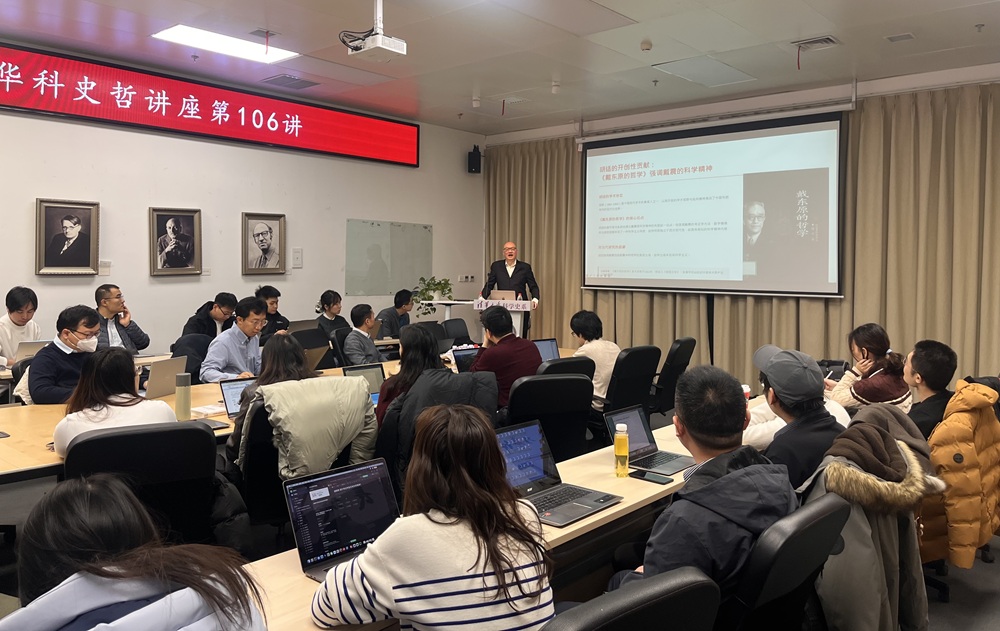
During the discussion session, in response to questions from teachers and students present, Professor Hu further elaborated on why Dai Zhen's philosophical thoughts were so outstanding that they could not be understood and inherited by scholars of his time. Dai Zhen's work demonstrated profound rationality and systematic characteristics, and traditional labels such as "Han learning", "Wan school" and "textual research" are completely inapplicable to him. Re-examining Dai Zhen and his academic heritage reminds us that within traditional Chinese culture, in addition to the mainstream of Song and Ming Neo-Confucianism, there exists another rational vein that values empiricism, emphasizes structure and pursues systematicness. This is of great practical significance for us to re-understand our own cultural traditions in the context of globalization today and explore a new path that can integrate Chinese classical wisdom with the spirit of modern science.
Written by: Chen Ke
Reviewed by: Sun Chengsheng