

On the morning of December 5, 2025, the Department of History of Science at Tsinghua University successfully held the 105th Tsinghua Lecture on History and Philosophy of Science in Room 124 of the Humanities Building. Pierrick Bourrat, Senior Lecturer at Macquarie University in Australia, was specially invited to give a lecture titled "Reproducees, Reproducers, and Darwinian Individuals". The lecture was chaired by Professor Wang Wei from the Department of History of Science. Bourrat specializes in philosophy of biology and co-leads the Research Group on Theory and Method in Biological Sciences with Paul Griffiths.
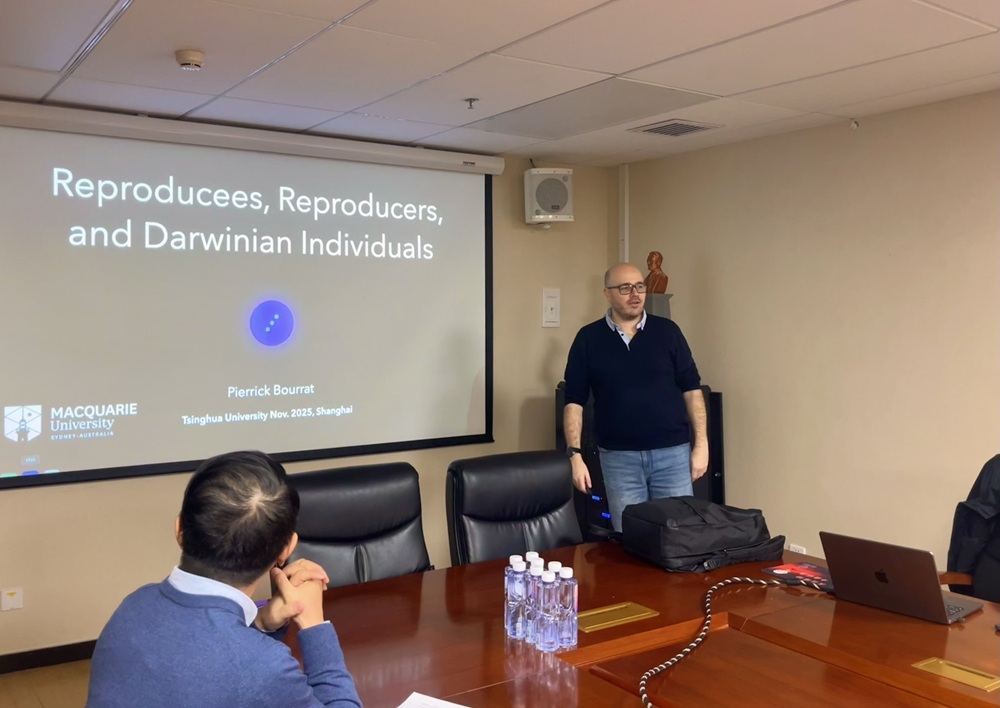
At the beginning of the lecture, Bourrat directly pointed out a fundamental yet confusing core concept in evolutionary theory - reproduction. He noted that although reproduction and its related concepts (such as heredity and replication) permeate all aspects of evolutionary thinking, there is no unified and clear definition in the philosophical and biological circles, and there are numerous terms with overlapping meanings or different emphases. To clarify the confusion, he proposed a conceptual analysis framework based on three layers of entities.
First, Bourrat defines the most basic concept of "Reproducee," which refers to an object that is produced or replicated. For an object B to be a reproducee of A, it must meet three minimum conditions: 1) Temporality (B appears after A); 2) Causality (A is the cause of B's existence); 3) Homogeneity (A and B belong to the same "relevant" category). Many entities discussed in evolutionary explanations, such as a gene or a heart in a multicellular organism, are merely "reproducees.
Next, he introduced another concept, "Reproducer". Reproducers are entities that can reproduce (relatively) autonomously. Their core characteristic lies in reproductive autonomy, which refers to the range of abilities to independently initiate and complete the reproductive process within a given environmental context. All reproducers (except for their initial origin) are also reproduced entities, but the reverse is not true. Autonomy forms a spectrum: a segment of DNA (extremely low), a virus (moderate), a bacterium or a frog (relatively high) are respectively at different positions in the transition from a "reproduced entity" to a typical "reproducer".
Furthermore, Bourrat argues for the progression from reproducers to "Darwinian Individuals". A typical Darwinian Individual (such as an organism capable of evolving complex adaptive traits) is not only a reproducer but also possesses a high degree of causal control over reproduction. This means that parents can accurately pass on their own subtle and deterministic trait changes to their offspring. It is this ability that enables cumulative natural selection, thereby evolving complex adaptive structures like the eye. Reproducers lacking such fine control have extremely limited evolutionary potential.
Subsequently, Bourrat used this framework to clarify two major controversies in the philosophy of biology. The first is about "whether genes are reproducers". He argues that in the context of multicellular organisms, genes and the heart are essentially "reproduced entities" that are highly dependent on the whole and lack autonomy. The key difference between the two lies in the degree of causal control over reproduction: small variations in gene sequences can be accurately inherited, while small changes in heart morphology usually cannot. Therefore, modern genes should be regarded as specialized modules that have evolved to perform high-fidelity information transmission functions. The second controversy is "whether reproduction requires material overlap". He intervened in and reconciled the famous debate between James Griesemer and Peter Godfrey-Smith (referred to as PGS). Bourrat points out that the cases (such as retroviruses) used by PGS to support "formal reproduction" (i.e., without material overlap) actually only intercept a fragment of the complete life cycle and describe this fragment entity as a "reproduced entity". If we track the complete life cycle process of a reproducer (such as the entire viral infection cycle), we will always find "hybrid objects" in which the components of future parents and offspring are mixed in material terms, and material continuity is inevitable. Therefore, the controversy stems in part from the different levels of the objects under discussion: formal descriptions can be made at the level of "reproduced entities", but to understand the evolution of "reproducers", it is necessary to examine the complete process involving material transmission.
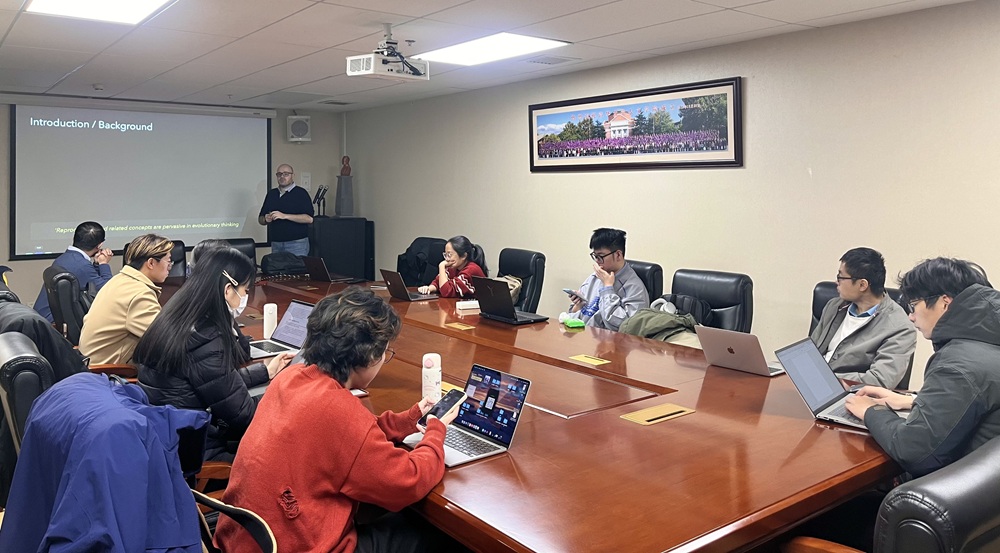
In the subsequent question-and-answer and discussion session, teachers and students on site engaged in in-depth and insightful exchanges on issues such as the precision of the conceptual framework (e.g., the definition of "cause" and "relevant category"), how horizontal gene transfer can be incorporated into the framework, whether the evolution of artificial intelligence challenges the requirement of material overlap, and the relationship between this framework and the debate on pluralism regarding the "unit of selection". Bourrat emphasized that his framework provides a set of analytical tools for clarifying the levels at which different scientific explanations operate, rather than seeking a metaphysically absolutely strict single standard. The selection of "relevant categories" depends on specific explanatory contexts and practical goals. Finally, the lecture concluded successfully with warm applause.
Written by: Huang Xin
Reviewed by: Wang Wei