

On the afternoon of November 13, 2025, the Department of History of Science at Tsinghua University had the honor of inviting Associate Professor Paolo De Troia from the Department of Chinese Language and Literature, Italian Oriental Institute, Sapienza University of Rome, and Executive Director of the Italian side of the Confucius Institute, to deliver the 104th "Tsinghua Lecture on History, Philosophy and Science of Science" in Room B206, Mengminwei Humanities Building. The theme of the lecture was "Taming the foreign falcon: Ludovico Buglio's Jincheng yinglun and the translation of European falconry in the Qing dynasty". The lecture was chaired by Associate Professor Jiang Che from the Department of History of Science.
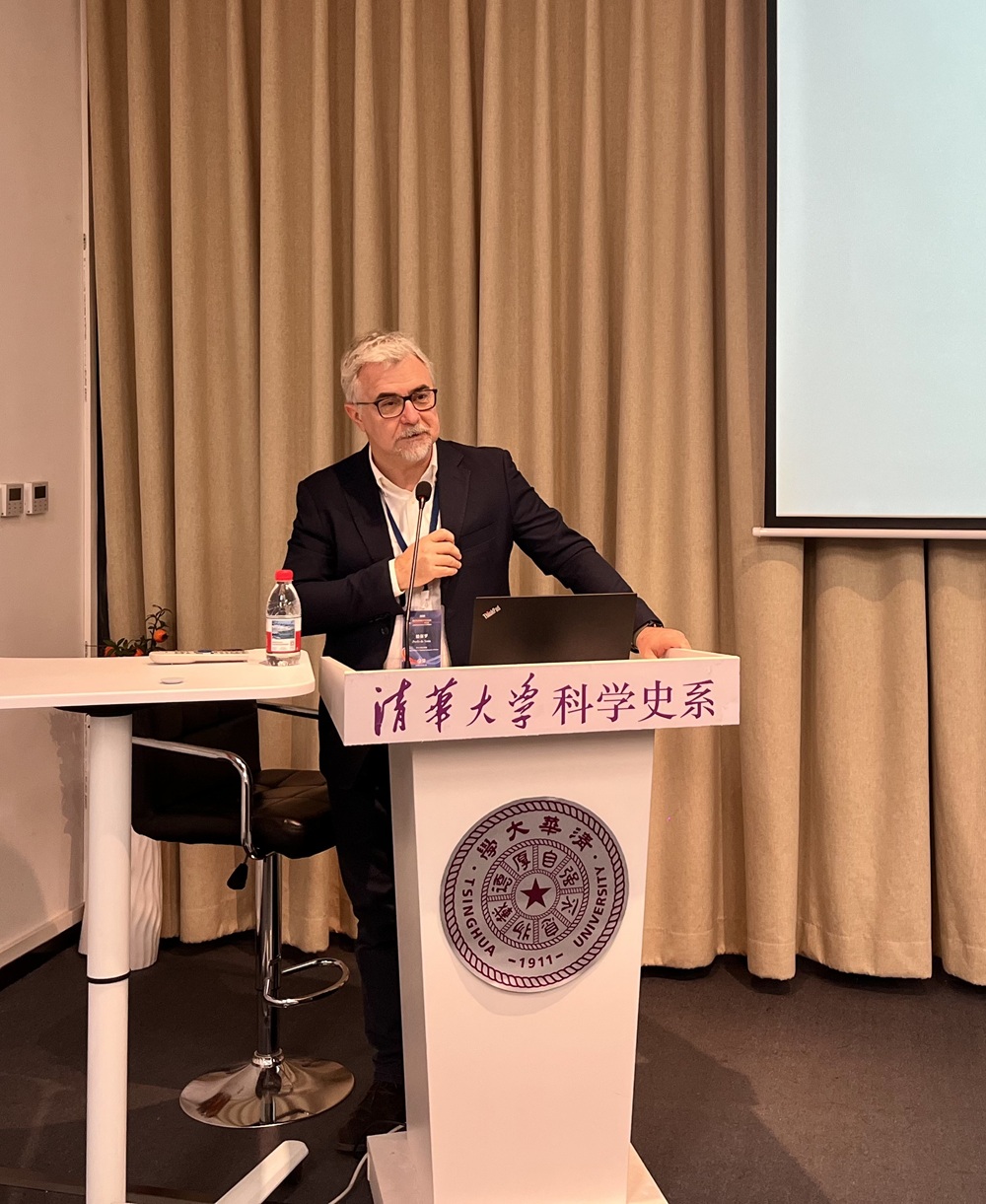
First of all, Professor Paul asked us to imagine such a scenario: On a certain morning in the 1670s, Emperor Kangxi asked the Jesuits if there were any Latin books on falconry and requested them to translate them into Chinese. This was the origin of the Italian missionary Ludovico Buglio (1606—1682) presenting *Jincheng Yinglun* (Treatise on Falcons Presented to the Emperor) to Kangxi in 1679. Professor Paul introduced the prerequisites for such cross-cultural knowledge exchange to be realized: first, the mastery of Chinese by Italian missionaries, which can be traced back to the efforts of early Italian sinologists in compiling dictionaries from the late 16th century to the 17th century, such as *Dizionario Portoghese-Cinese* (Portuguese-Chinese Dictionary) compiled by Michele Ruggieri and Matteo Ricci in Zhaoqing from 1583 to 1588, *Xizi Qiji* (Miracles of Western Characters), the first work that used Latin letters to spell Chinese, compiled by Matteo Ricci in Beijing in 1605, and *Grammatica Sinica* (Chinese Grammar) written by Martino Martini around 1652; second, the strategic choice of Italian missionaries to use "science" as a core tool in their missionary work and attempt to communicate with Chinese scholars on the basis of mutual respect. For example, Michele Ruggieri (1543—1607), as the first missionary to adopt this strategy, pioneered the translation of the Confucian classic *Daxue* (The Great Learning) into Latin, and extracted "gewu" (gewu, investigation of things) from it, making it a term that can be translated equivalently with Western concepts of natural science.
Professor Paul respectively introduced the tradition of "falconry" as recorded in Eastern and Western history. Falconry, the art of training birds of prey (mainly eagles) to catch game, has its origins in Asia. One of the earliest physical evidences is a relief from the era of Assyrian King Sargon II (722–705 BCE). After Germanic tribes introduced falconry to the Roman Empire around 400 CE, it became popular in medieval Europe and reached its peak. *De arte venandi cum avibus* by Holy Roman Emperor Frederick II is a comprehensive work that combines ornithology and falconry. There was also an exchange of falconry knowledge between Arabs and the King of Italy in Sicily. This golden age quietly came to an end with the widespread use of firearms in hunting activities during the 17th and 18th centuries. In ancient China, records of falconry practices can be traced back to Li Si in *Records of the Grand Historian*, who was described as "leading a yellow dog and carrying a goshawk on his arm", and Li Heng from Maoling who named falcons in Ge Hong's *Miscellaneous Records of the Western Capital*. Images of falcons used in hunting have also been found in the bronze plate decorations unearthed from the Xichagou tomb complex in Liaoning. We can also glimpse the prosperity of falconry activities from some records from the Northern and Southern Dynasties to the Song Dynasty, such as the grand occasion recorded in *History of the Northern Dynasties* in 605 CE where "falconers from all over the country gathered in the Eastern Capital", and the "merchants selling eagles and goshawks" recorded in the chapter "Streets and Alleys at the East Corner Tower" of *Dreams of Splendor of the Eastern Capital*. More recent accounts, such as Marco Polo's *Travels* and descriptions by French missionary Jean-François Gerbillon, also provide collateral evidence for ancient Chinese falconry activities.
Following Father Jean-François Gerbillon's anecdotal account of Emperor Kangxi's fondness for falconry, Professor Paul turned the conversation back to Emperor Kangxi's interest in science and *A Treatise on Hawks Presented to the Emperor*. Starting from 1669, when Kangxi summoned Ferdinand Verbiest to be his teacher of Western learning, an increasing number of Jesuits were called to his side to instruct him in various subjects, with Lodovico Buglio being one of them. He completed his translations *On Lions* and *A Treatise on Hawks Presented to the Emperor* in 1678 and 1679 respectively, which were identified by Fang Hao, a great scholar of Sino-Western cultural exchange history, as "the earliest Western zoological books translated into Chinese". Professor Paul shared more detailed information about *A Treatise on Hawks Presented to the Emperor*, such as the discovery by Paul Pelliot, a French sinologist of the last century, of two short prefaces to the work (one by Lodovico Buglio and another by Liu Ning, a Chinese Catholic of the same era) in the manuscript of *Collected Explanations of Heavenly Learning* preserved in the National Library of Russia in Saint Petersburg.
Professor Paul has conducted a detailed analysis of the translation practice method in the compilation of *Jincheng Yinglun* (A Treatise on Eagles Presented to the Throne), namely "oral interpretation and written transcription". The original text of *Jincheng Yinglun* is the late 16th-century Latin book *Ornithologiae, hoc est, De avibus historiae* by Ulisse Aldrovandi (1522—1605), a Bolognese naturalist revered as the "father of natural history". Professor Paul presented some contrasting tensions between the Latin original and the Chinese translation, reflecting the losses and adaptations in the translation process. For example, "humidi cholerici" (one of the four humors in the Hippocratic medical tradition, known as "yellow bile") was translated as "yellow phlegm", and "cauterio" (a traditional Western medical technique of cauterization) was translated as "moxibustion". Therefore, Professor Paul pointed out that "oral interpretation and written transcription" is a true space for cultural exchange and a "rabbit hole" that allows us to enter the intellectual environment of that time.
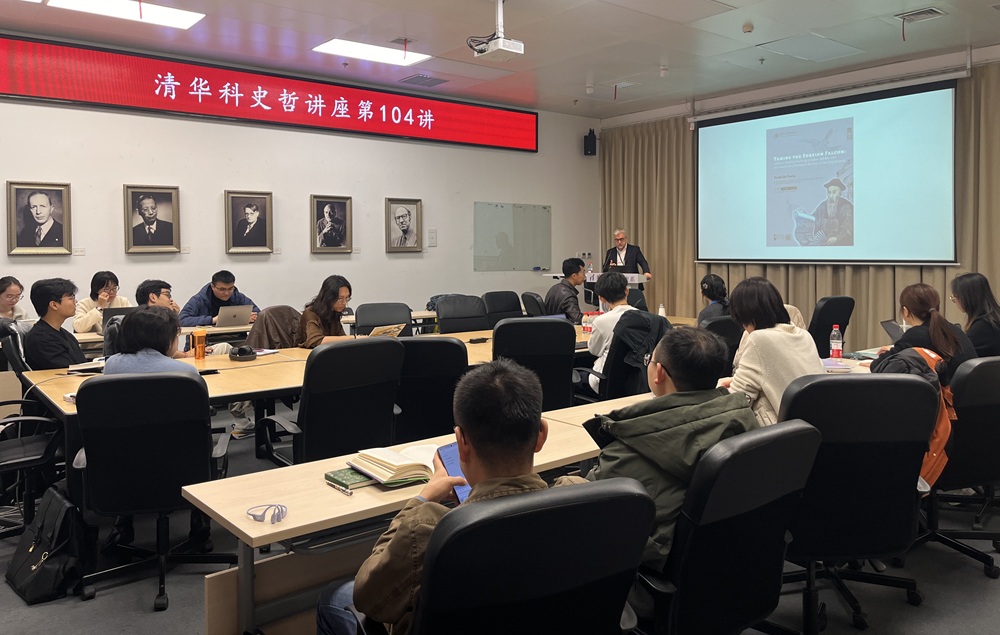
After the lecture, the teachers and students present had an in-depth discussion with Professor Paul on issues such as the handwriting in the collections of the Beitang Library, the early learning experiences of Lodovico Buglio, and the subsequent reception of "Jincheng Yinglun" (A Treatise on Hawks Presented to the Emperor). Regarding the reception of "Jincheng Yinglun", Professor Paul added that the limited response to it might be related to the fact that its author did not use specialized Chinese falconry terms, and people at that time read it more out of curiosity about foreign knowledge rather than a demand for practical learning.
Written by: Zheng Zhongtian
Reviewed by: Jiang Che