

On the afternoon of November 13, 2025, the Department of History of Science at Tsinghua University held the 103rd Tsinghua Lecture on History and Philosophy of Science in Room B206 of the Meng Minwei Humanities Building. Li Yunyi, an associate researcher at the Institute for the History of Natural Sciences, Chinese Academy of Sciences, was invited to give a lecture entitled "Military Utilization of French Nuclear Technology and the Development of Strategic Deterrence Forces". The lecture was hosted by Professor Shen Yubin from the Department of History of Science. Li Yunyi has long been engaged in research on the history of French science and technology, the history of world science and technology, and the history of Sino-French scientific and technological exchanges, with profound accumulation in the history of nuclear science and technology system, the history of scientific and technological diplomacy, and scientific and technological strategies during the Cold War. This report systematically sorted out the origin, technological breakthroughs, institutional structure and strategic positioning of French nuclear forces, and combined with detailed historical materials, provided a highly concise and insightful historical analysis on this topic.
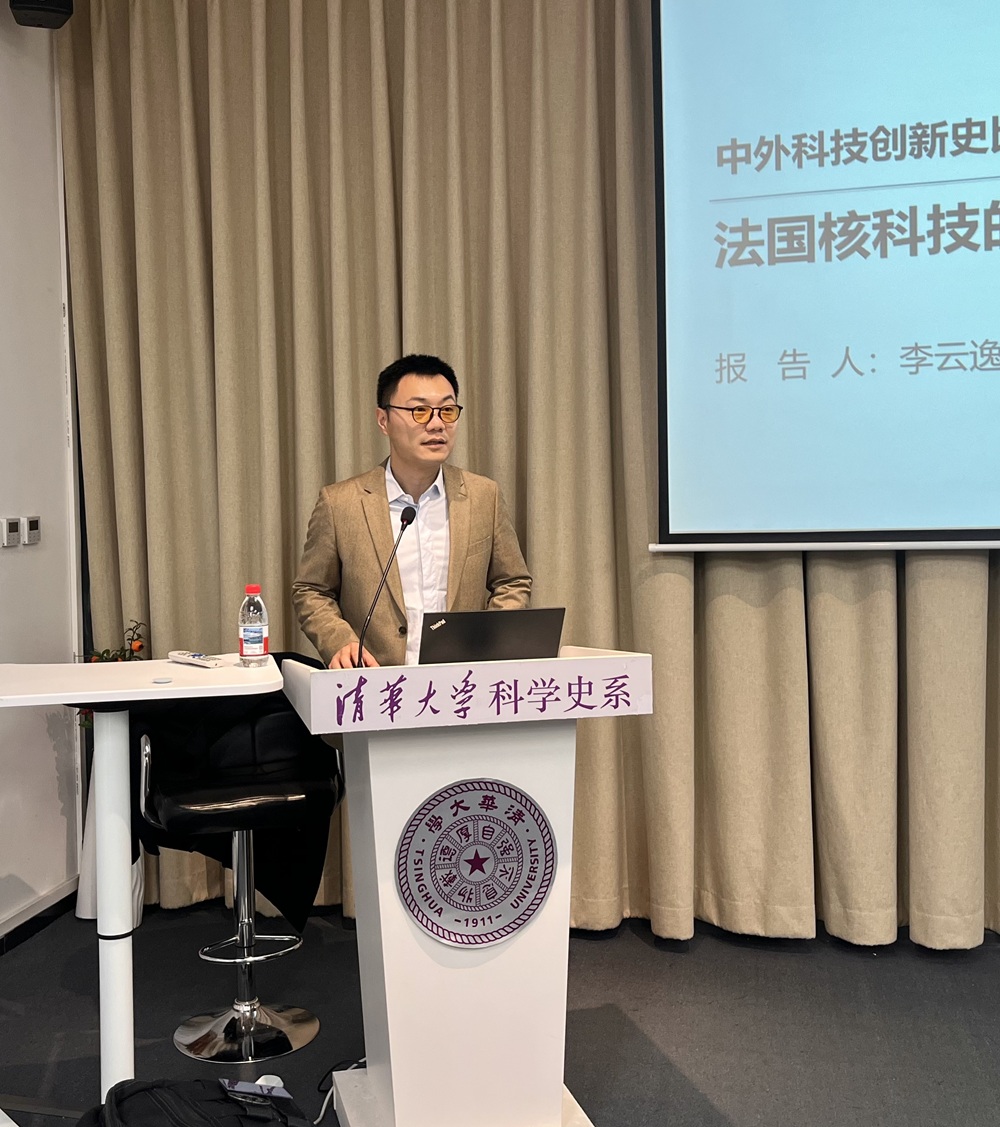
At the beginning of the lecture, Li Yunyi reviewed France's leading position in nuclear science exploration in the first half of the 20th century. The Joliot-Curie team achieved a series of original results in nuclear fission experiments, chain reaction mechanisms, and early conceptions of nuclear energy devices, and applied for the world's earliest patents related to nuclear energy and nuclear explosives in 1939. Although these studies were forced to be interrupted due to the outbreak of World War II, their scientific accumulation, institutional foundation, and symbolic significance later became an important starting point for France to rebuild its nuclear science and technology system. After the war, the de Gaulle government established the Atomic Energy Commission, attempting to restore France's international status in the field of nuclear science and technology with national strength. Joliot-Curie emphasized the peaceful use of nuclear energy, but the international situation in the context of the Cold War, the instability of Franco-American relations, and France's anxiety in the global power structure led the national decision-makers to gradually turn to nuclear weapons research and development. The failure of the United States to provide the expected support to France in the Battle of Dien Bien Phu in 1954, and the dual pressure from the United States and the Soviet Union on Britain and France during the Suez Crisis in 1956, further deepened France's strategic pursuit of "nuclear autonomy". It was against this geopolitical background that the government of the Fourth Republic successively approved secret nuclear weapons development plans and laid the policy foundation for subsequent construction.
Under the combined effect of the state-led scientific research system and the long-established elite education system, France gradually overcame key technical obstacles such as plutonium production, nuclear material forging, implosion systems, and neutron ignition. Despite the strict blockade of core technologies by the United States and the United Kingdom against France, French researchers achieved a breakthrough from scratch through independent research and development. In 1960, France's first atomic bomb successfully exploded at the Algerian Sahara test site. With a yield of 60,000 tons, it not only far exceeded the level of the first nuclear tests conducted by the United States, the Soviet Union, and the United Kingdom, but also became an important symbol of France's "self-reliance and self-strengthening" narrative. Li Yunyi pointed out that the notable innovations in France's first atomic bomb include a more sophisticated implosion structure and the design using an external neutron source for ignition, and these achievements have had a fundamental impact on France's subsequent construction of a complete nuclear arsenal.
However, possessing an atomic bomb does not equate to having a credible nuclear strike capability. Li Yunyi further analyzed how France achieved the leap from "possessing nuclear weapons" to "having nuclear deterrence capability" in terms of technology, strategy, and institutions. France initially assigned the task of nuclear strikes to Mirage bombers, but their deterrence credibility was questioned due to limitations in range, penetration capability, flight path, and other factors. Therefore, the de Gaulle government promoted the parallel development of land-based and sea-based medium-range ballistic missiles and accelerated the miniaturization of atomic warheads. In the 1970s, French land-based missiles were deployed on the Massif Central, and strategic nuclear submarines were commissioned and equipped with submarine-launched ballistic missiles. By then, a "strike force" consisting of air-based, land-based, and sea-based components had been formed, making France the only country in Europe with a "triad" nuclear deterrence system.
When discussing the development of the hydrogen bomb, Li Yunyi pointed out that France's process was relatively tortuous. The Atomic Energy Commission did not attach sufficient importance to the hydrogen bomb program in the early days. It was not until learning that China had made key progress that de Gaulle promoted the acceleration of the development. However, there were long-standing disputes within France over the configuration, route, and test design. Finally, the first hydrogen bomb was successfully tested in 1968, which was later than the original target. This period of history highlights the differences in technical culture within France's nuclear science and technology system and also reflects the strong traction of international nuclear competition on national strategic judgments.
Entering the 21st century, while maintaining a limited size of its nuclear arsenal, France has continued to take strategic nuclear submarines as the core of its deterrence, supplemented by air-based nuclear forces to enhance flexibility. In recent years, political discussions on the relationship between French nuclear forces and European security have once again attracted attention. Li Yunyi pointed out that France has the ability to implement strategic deterrence against major powers, but whether and how its nuclear deterrence extends to European allies is not only determined by nuclear technology or the size of its arsenal, but is more closely related to European strategic autonomy, alliance structure and French political traditions.
At the end of the report, Li Yunyi summarized three key factors that enabled France's nuclear technology to achieve "self-reliance and self-strengthening": first, the firm national will maintained across governments, which allowed complex large-scale scientific projects to advance continuously; second, the long-term accumulated system of scientific research institutions and talent training mechanisms, which provided a stable knowledge structure for tackling key problems in nuclear technology; third, the uranium resources and test sites provided by France's mainland and colonial system, which laid the material foundation for the nuclear program. France's experience is not only applicable to nuclear technology, but also provides important enlightenment for emerging strategic fields such as artificial intelligence and advanced manufacturing at present.
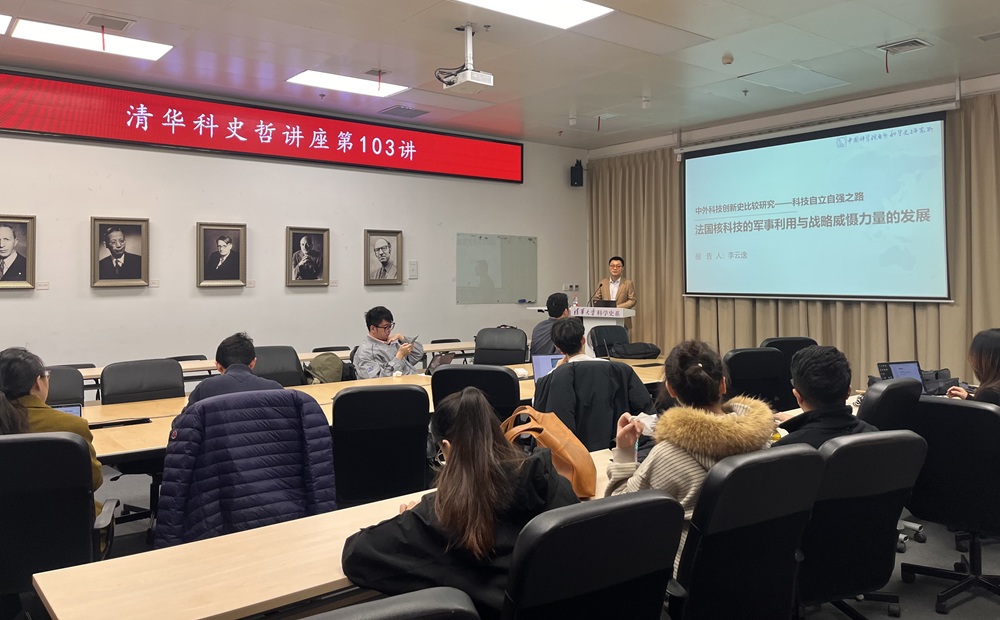
In the subsequent question-and-answer and discussion session, teachers and students at the scene had a lively and in-depth exchange with Li Yunyi on multiple levels. The topics focused on the access channels and restrictions of research historical materials and archives, the development logic of French civil nuclear energy and its current research landscape, the methodological tension between the history of science and critical historiography in nuclear technology research, the complex interaction between "foreign aid" and "self-reliance" in the development of nuclear technology at home and abroad, and the re-examination of nuclear test history from the perspective of colonies and post-colonies. Li Yunyi responded to each question in detail, and further clarified and expanded on specific historical materials and research paths. Finally, the lecture concluded successfully with warm applause from the audience.
Written by: Huang Xin
Review: Shen Yubin