

On the morning of November 4, 2025, the Department of History of Science at Tsinghua University held the 102nd Tsinghua Lecture on History and Philosophy of Science in Room B206 of the Mengminwei Building of Humanities. Professor Victor Katz gave a lecture entitled "Musings on Greek Mathematics". The lecture was hosted by Associate Professor Jiang Che from the Department of History of Science.
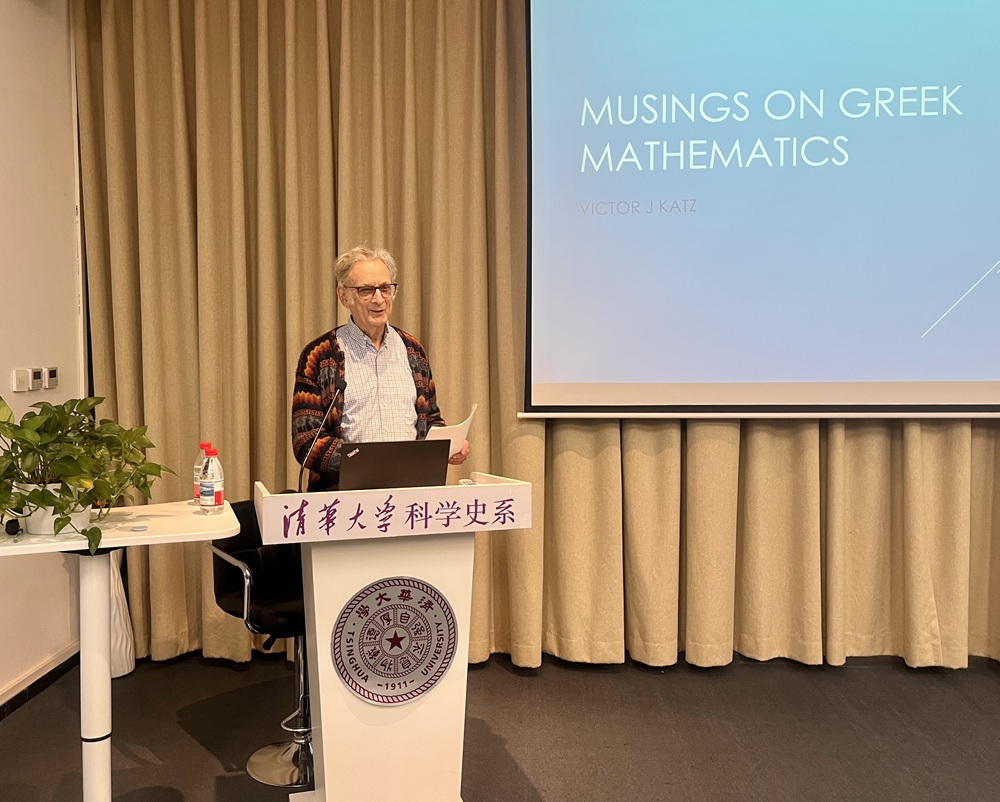
Professor Victor Katz began his lecture with the naming of the "Pythagorean theorem". Although the Greeks named the 47th proposition in the first volume of Euclid's "Elements" after "Pythagoras", the theorem that "the sum of the squares of the two legs of a right-angled triangle is equal to the square of the hypotenuse" (Pythagoras Theorem, Gougu Theorem) also exists in other mathematical civilizations around the world, and there is no direct historical evidence linking this name to Pythagoras.
Professor Katz went on to ask, what is Greek mathematics? First of all, Greek mathematics does not refer to mathematical works written in the mainstream region of Greece (Attica), because Pythagoras, mentioned earlier, spent most of his life living on the island of Sicily. Secondly, Greek mathematics does not solely refer to mathematical propositions written in (common) Greek. Not to mention that this language has been constantly changing, the mathematical propositions written in Latin in the Western Roman Empire are also part of our consideration. Moreover, the mathematical propositions written on papyrus and clay tablets, as well as the mathematics studied in the places conquered by Alexander the Great, are all part of Greek mathematics: mainly in the Eastern Mediterranean region, with a time span of approximately from 400 BC to 600 AD.
Next, Professor Katz used the following two main examples to illustrate that the presentation of Greek mathematical propositions in records of different civilizations/texts supports the above generalized definition of Greek mathematics.
The first example is a proposition about the diagonal of a square. As shown in Figure 1, the general description is to give the side length and the diagonal length, and the problem is to find the area of the square or to give the sum of the side lengths to find the diagonal length. The common solution in modern mathematics uses the principle that "the square of the sum minus the square of the difference equals four times the area", that is, (a+b)² - (a-b)² = 4ab. Existing records of this problem can be found in: 1) Babylonian evidence, the stone tablet numbered BM34568 now in the British Museum; 2) Egyptian evidence, the Papyrus Cairo now in Paris; 3) Roman evidence, said to be a work by Marcus Junius Nipsus (Podismus), a Roman surveyor of the 2nd century AD; 4) evidence from a 2nd-century AD papyrus now in Geneva.
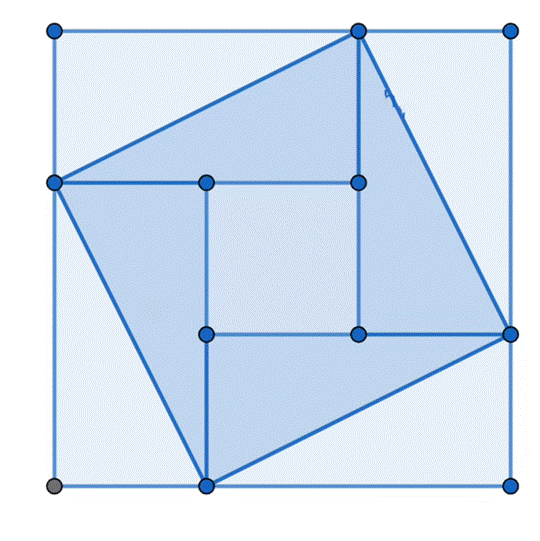
(Image excerpted from Professor Katz's lecture presentation)
The above diagonal problem can be transformed into a proof of the "Pythagorean theorem" by moving the position of the triangle. Meanwhile, these similar proofs in different languages indicate that geometric problems might have spread orally along the eastern Mediterranean coast. It should be added that similar geometric proofs are also recorded in Zhao Shuang's Annotation of Zhou Bi Suan Jing during the Han Dynasty.
The second example is the problem of calculating the area of a circular segment. First, Hero (or Heron) of Alexandria, who lived in the 1st century AD, recorded two methods for calculating the area of a circular segment in his book *Metrica* (Metrica). One is an ancient method: add the length of the chord and the height of the circular segment, multiply the sum by the height, and then divide by two, i.e., ½(c + h) × h. This method is relatively accurate only when the circumference ratio (π) is taken as the integer 3. The other is an improved method mentioned by Hero, which is based on Archimedes' precise calculation of the circumference ratio: ½(ch) + ¹⁄₁₄(ch)². Hero presented another form of propositions in geometry, which consists of problems and their solutions, differing from the axiomatic deductive structure of classical Greek geometry. Secondly, such geometric problems also appear in different texts. For instance, the problems recorded in Hero's *Geometrica* (Geometrica) can also be found in *De Re Rustica* by Lucius Junius Moderatus Columella, a 1st-century AD Latin agronomist, as well as in the collections of Roman surveyors. Finally, what distinguishes Hero from other records of practical mathematics is that he not only provided methods for solving specific geometric problems but also gave "algorithms" or rules for the thinking process behind solving these problems.
Professor Katz finally discussed the "arithmetic" in Greek mathematics. The computational problems recorded by Diophantus, who was active in the 3rd century AD, in his *Arithmetica* consist of sets of specific problems, solutions, and rules, just like the geometric problems before them. These problems can also be found in the following discussions: 1) *Al-Fakhri* by the 11th-century Persian mathematician Al-Karaji; 2) discussions by the great 13th-century Italian mathematician Fibonacci and Ibn al-Banna; 3) the "travel problems" by the 16th-century Jewish scholar Elijah Mizrachi. Diophantus' use of symbols/notations also made his arithmetic problems basic algebraic problems.
Going back to Pythagoras, Professor Katz pointed out the factual issues in the records from the discussions on musical ratios by Nichomachus of Gerasa in the 1st century AD and Boethius in the 5th century. The Greeks merely attributed these mathematical propositions to Pythagoras, and the propositions themselves are not restricted by language or region. Finally, Professor Katz concluded the lecture by citing Vitruvius' praise of Greek knowledge in "De Architectura".

After Professor Katz's lecture, the venue entered an in-depth academic discussion session. The participating teachers and students, centering on the content of the lecture, put forward a series of profound questions from different perspectives. Teacher Jiang Che first pointed out the expression way of geometric problems in Columella's writings and raised questions about the more macroscopic issue of Greek mathematical historiography. Professor Katz gave an incisive response, noting that although "returning to the context" has become a consensus in interpreting Greek mathematics nowadays, researchers still need to carefully distinguish between two essential issues: "how Greek mathematicians thought" and "how Greek mathematics was used". Subsequently, Teacher Liu Dun discussed the details of the dissemination history of Persian/Arabic mathematics and the "double false position method" with Professor Katz. Student Liao Yuqing put forward some thoughts on the internal connection between the parallel postulate and the "Pythagorean theorem" in Euclid's *Elements*. The scope of the discussion was further expanded. Teacher Pan Shuyuan discussed with Professor Katz the difficulty in preserving ancient Chinese and Western mathematical texts, while Teacher Wang Zheran continued to ask questions about the details of the lecture. The entire discussion session was rich and profound.
Written by: Liao Yuqing
Reviewed by: Jiang Che