

On the morning of October 24, 2025, the Department of History of Science at Tsinghua University successfully held the 101st Tsinghua Lecture on History and Philosophy of Science in Room B206 of the Mong Man Wai Building for Humanities. The lecture, titled "The Place of Explanation: Structural Realism and the Dependency Account of Explanation", was given by Professor Emeritus Jim Woodward from the University of Pittsburgh. It was hosted by Professor Wang Wei from the Department of History of Science.
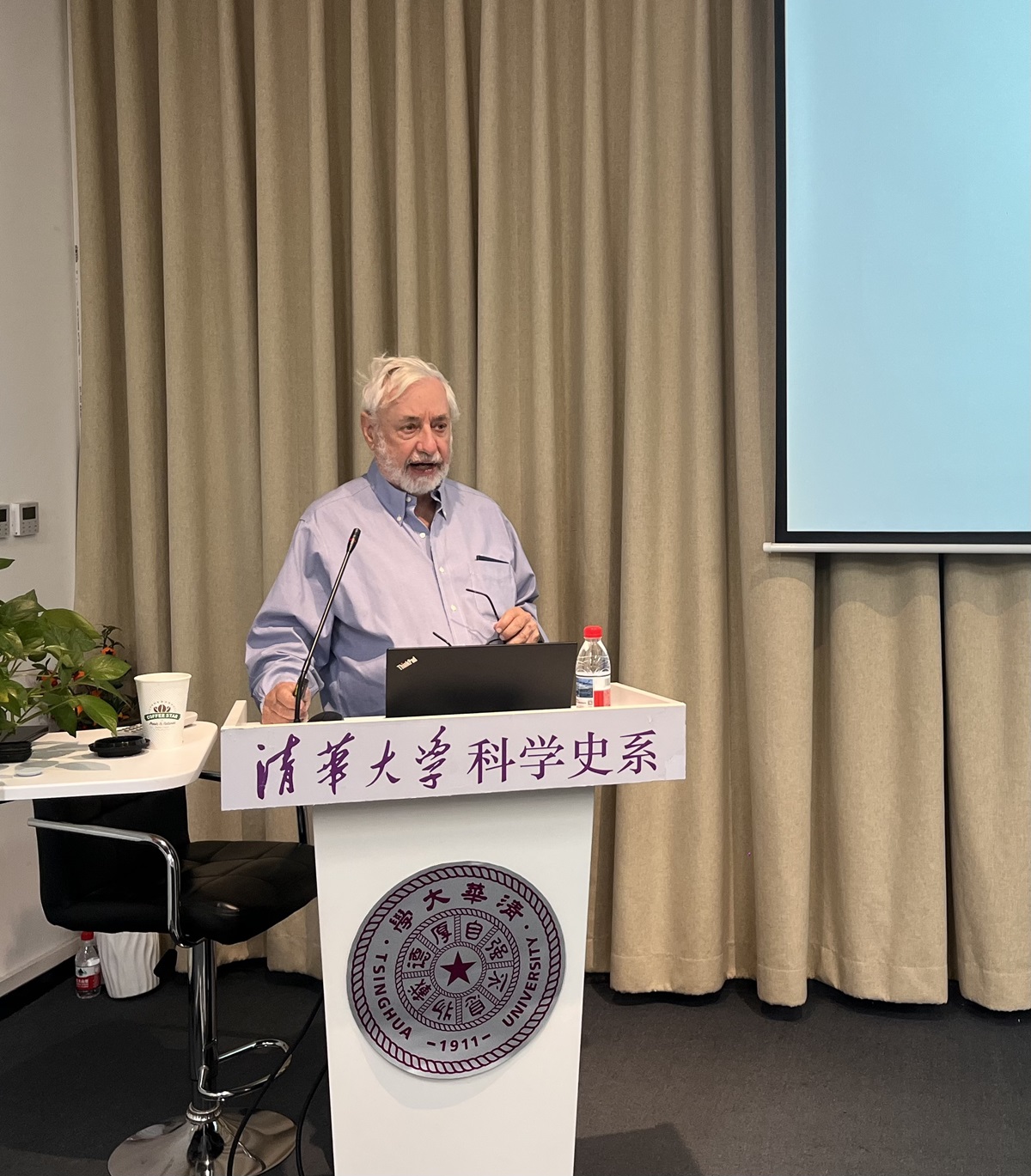
Woodward's research covers general philosophy of science, with a particular focus on issues of causality and scientific explanation. His book *Making Things Happen* (2003) won the Lakatos Award in 2005, and he is also the author of *Causation with a Human Face* (2021). He is a Fellow of the American Academy of Arts and Sciences and a Fellow of the American Association for the Advancement of Science, and in 2024, he was awarded the Hempel Award by the Philosophy of Science Association.
At the beginning of the lecture, Woodward guided the audience to reflect on the deeper goals of scientific practice. He clearly stated at the outset that explanation, like the discovery of truth, is an indispensable core goal of science. In response to the tendency in the philosophical community (especially among scientific realists) to regard "the pursuit of truth" as the sole cognitive goal of science, Woodward put forward a more refined concept - "Effective Correctness". He emphasized that what science pursues is not truth without boundaries, but theoretical claims that are approximately accurate in specific application fields and can serve specific scientific activities. Among them, what science values most is Dependency Relations, that is, those relations that can systematically answer "What-if-things-had-been-different" questions (i.e., counterfactual conditions), rather than the precise description of Ontology.
Based on this insight, Professor Woodward systematically expounded his Dependency Account explanatory model. He particularly emphasized that this model is Minimalist, meaning it actively strips away many of the additional burdens that traditional philosophy has imposed on explanation. A successful explanation does not necessarily need to possess so-called Explanatory Virtues such as "unity" or "simplicity"; its only key lies in whether it can effectively and correctly depict the structure of dependency relationships behind phenomena. To corroborate the persuasiveness of this view, Professor Woodward cited a series of scientific cases, including Brownian motion, the early discovery of electrons, and the validity and limitations of Newtonian gravitational theory within the framework of general relativity. He pointed out that scientists can completely succeed in grasping key dependency relationships and thereby provide satisfactory scientific explanations even when they fail to correctly understand or even completely misunderstand ontology.
This perspective that prioritizes dependencies leads to a novel version of Structural Realism. Woodward explicitly equates "structure" with networks of dependencies and refers to his position as "Instrumental Realism." The core of this stance is that we should adopt a firm realist attitude toward the dependency relations described by scientific theories, acknowledging that they reflect the real structure of the world; however, we can maintain a relatively relaxed and pragmatic attitude toward the ontology of the entities involved in these relations. The reason for this is that different and even seemingly conflicting ontological frameworks in the history of science can entirely describe the same dependency structures.
In terms of inferential methodology, Woodward explicitly opposes Inference to the Best Explanation (IBE), which is extremely popular in the philosophy of science. He argues that IBE makes a fundamental mistake: mistakenly treating a hypothesis's "explanatory potential" as evidence supporting its truth. From Woodward's perspective, explanatory potential can only support our inclusion of it in the context of "Pursuit," that is, investing resources in further research and testing, but it can never directly serve as a reason to believe it is true, valid, or correct. In contrast, he advocates for a more rigorous and robust model of scientific reasoning: Inference to the Only Explanation (IOE), which ultimately achieves the goal by systematically eliminating all other possible competing explanations through independent empirical evidence. He takes the common problem of Confounding Variables in causal inference as an example to reveal how IBE-style reasoning, which prefers direct causal hypotheses based solely on virtues such as "simplicity," is incompatible with prudent scientific practice.
Finally, Woodward delves into the implications of his views for the classic debate over scientific realism. He is particularly critical of arguments that reason along the lines of "the success of a theory requires an explanation, and the realist explanation is the best one," dismissing them as circular and unconvincing. He reiterates that the only solid basis for the rational acceptance of any theory (including the dependencies it describes) lies in the systematic elimination process demanded by IOE, which is grounded in independent empirical evidence, rather than any a priori philosophical presuppositions about what constitutes the "best" explanation.
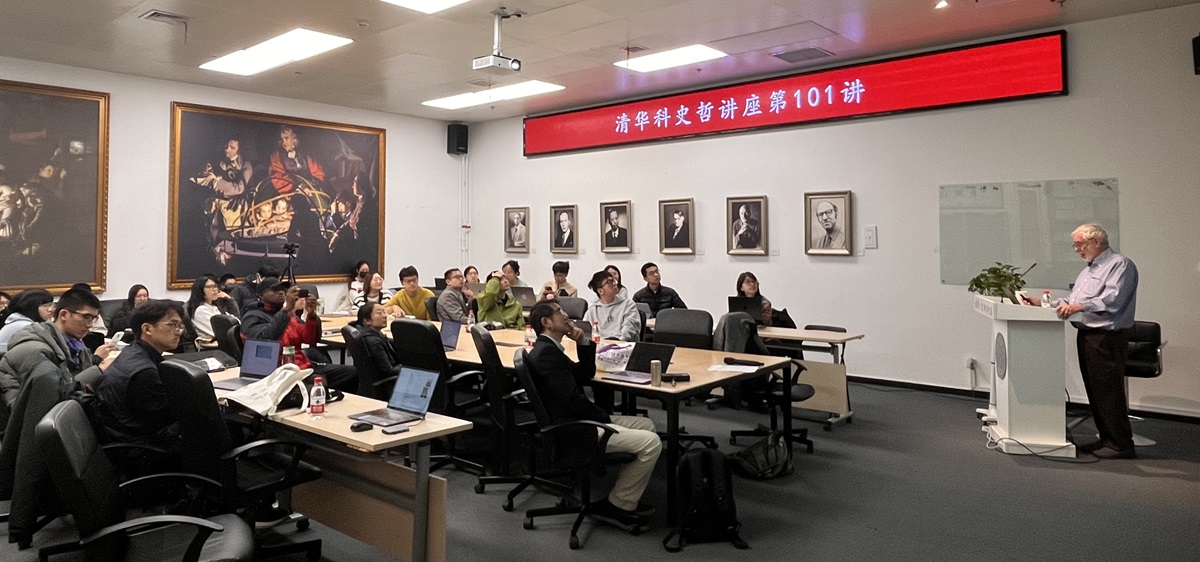
In the subsequent Q&A and discussion session, teachers and students at the scene had in-depth exchanges with Woodward. The discussions focused on issues such as the typology of dependency relations (whether they are limited to causal relations), the actual tension between the elaboration of dependency and ontology in scientific practice, the applicability of IOE in situations with limited data, and the similarities and differences between its viewpoints and other schools of structural realism. Woodward responded to these questions in detail one by one, further clarifying his philosophical stance. Finally, the lecture came to a successful conclusion amid warm applause from all teachers and students.
Written by: Huang Xin
Reviewed by: Wang Wei