

On the afternoon of September 25, 2025, the Department of History of Science at Tsinghua University held the 99th Tsinghua Lecture on History and Philosophy of Science in Room B206 of the Humanities Building. The lecture was honored to invite Professor Dagmar Schäfer, Director of the Max Planck Institute for the History of Science in Germany and Head of its Third Department, to deliver a keynote speech titled "Digital Double Helix: Computer Methods as Tools and Objects in the History of Knowledge". Associate Professor Xiang Jing from the School of History at the University of Chinese Academy of Social Sciences served as the commentator, and the lecture was hosted by Associate Professor Shen Yubin from the Department of History of Science. Nearly 50 teachers and students from Tsinghua University and universities and research institutions around Beijing attended the lecture.
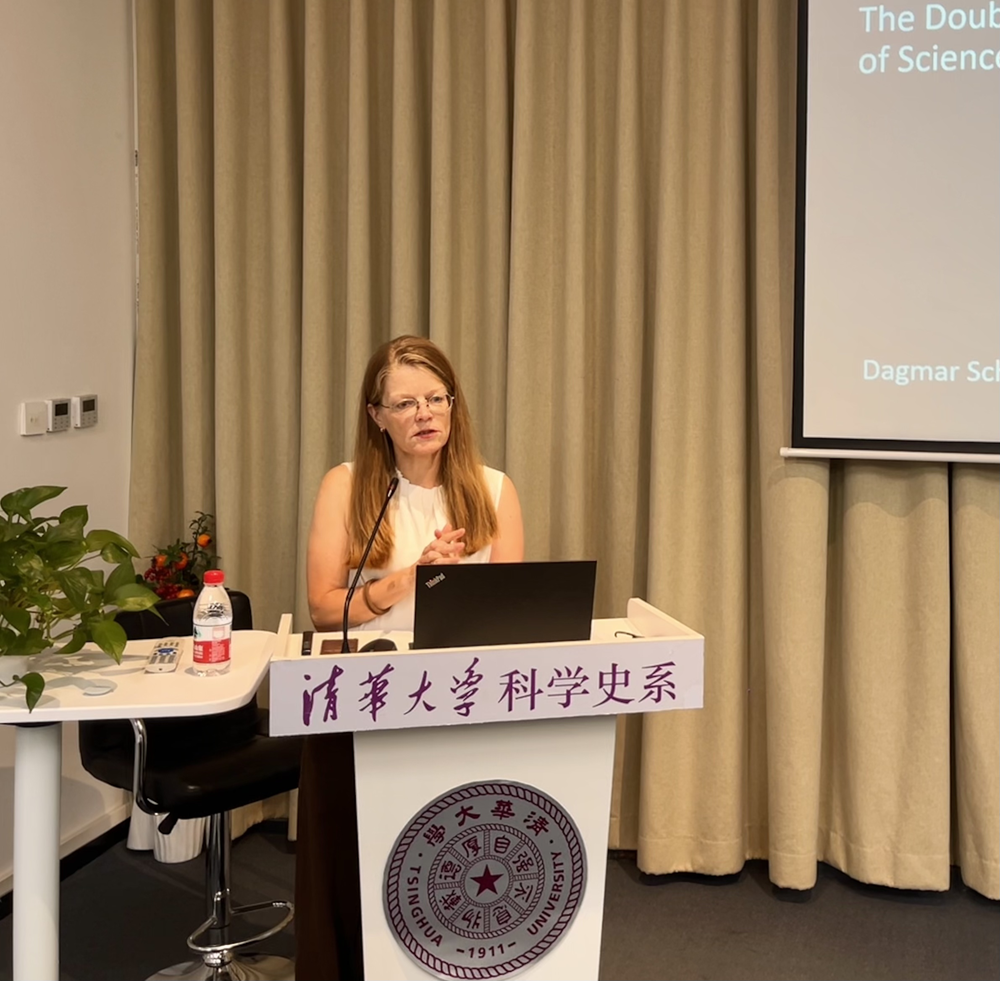
Professor Xue Feng pointed out that over the past fifty years, computer methods, as an analytical tool, have profoundly transformed the methodology of history, giving rise to new ways of thinking. Meanwhile, digital practice itself is an important research object, as this technology is deeply embedded in social and power dynamics. Emerging digital technologies such as artificial intelligence not only simulate human performance but also reproduce and reshape the fundamental ways humans perceive and understand things. She pointed out the three-layer corresponding relationship between digital and humanities in terms of cognitive modes: consistency and rationality, repetition and reliability, recombination and creation. The consistency in algorithmic operations reflects humans' pursuit of rationality, establishing outputs on the basis of formal coherence and reasoning logic; artificial intelligence relies on repetition, which reflects the principles of reliability and reproducibility in human scientific research; artificial intelligence generates content through the recombination of elements, which is similar to the creative thinking of humans in rearranging existing knowledge. Afterwards, Professor Xue Feng discussed these three corresponding relationships one by one based on the exploration results in the field of digital humanities at the Max Planck Institute for the History of Science.
- Consistency and rationality. Professor Feng Xue used the local chronicles research project of the Max Planck Institute as an example to illustrate the impact of artificial intelligence on the study of the history of science. In the study of local chronicles, it is believed that the local knowledge produced by local chronicles forms the basis for creating more universal forms of knowledge. Professor Feng Xue argues that digital humanities tools are a double-edged sword, which may either obscure or reveal the dynamics between the two types of knowledge, help discover biases, or introduce new ones. If used properly, digital humanities tools can help clarify the progressive processes of homogenization and specialization in history. In machine learning, machines look for statistical patterns in data and extract consistent features from materials. Machines' understanding of consistency initially relied on manual annotation, but now algorithms are gradually freeing themselves from this dependence on humans. The way machines process data is similar to the cognitive approach that historians of science face in local chronicles projects, as both pursue consistency and rationality. In engineering, machines may deviate from consistency, but in reality, humans also learn with errors.
- Repetition and reliability. Professor Feng Xue gave an introduction focusing on the issue of text repetition in the project on Chinese ancient encyclopedias at the Max Planck Institute. One of the characteristics of the production mode of ancient Chinese knowledge is the respect for the repetition of the same knowledge. Ancient China revered common knowledge such as "investigating things to acquire knowledge" and "the way of great learning", and kept repeating them, taking them as premises that did not need to be checked. This approach is consistent with what computers actually do in terms of repetition. In machine learning, repetition makes pattern recognition and model training possible. In the integration of digital humanities, computers need to be able to learn how knowledge is copied, revised, and expanded. Professor Feng Xue believes that repetition should not be regarded as conservative; instead, like artificial intelligence, it should be regarded as an epistemological signal, from which deep cognitive structures and historical dynamics can be discovered.
- Recombination and creation. Professor Xue Feng elaborated with the example of the Max Planck Institute's celestial visualization project. Humans often forget, but computers do not. However, it is precisely forgetting that keeps human memory alive, and artificial intelligence should also learn to forget. In the study of the history of science, reconstructing historical archives and questioning existing classifications are very important. Current research on the history of science focuses on text and visual culture, with relatively few studies on material culture such as Dunhuang sculptures. In the celestial visualization project, researchers collect visual images depicting celestial bodies from various materials and use artificial intelligence to integrate information beyond the capacity of the human brain, thereby revealing potential visual or material affinities and breaking through disciplinary boundaries. Such a platform breaks the geographical limitations on the study of the history of science.
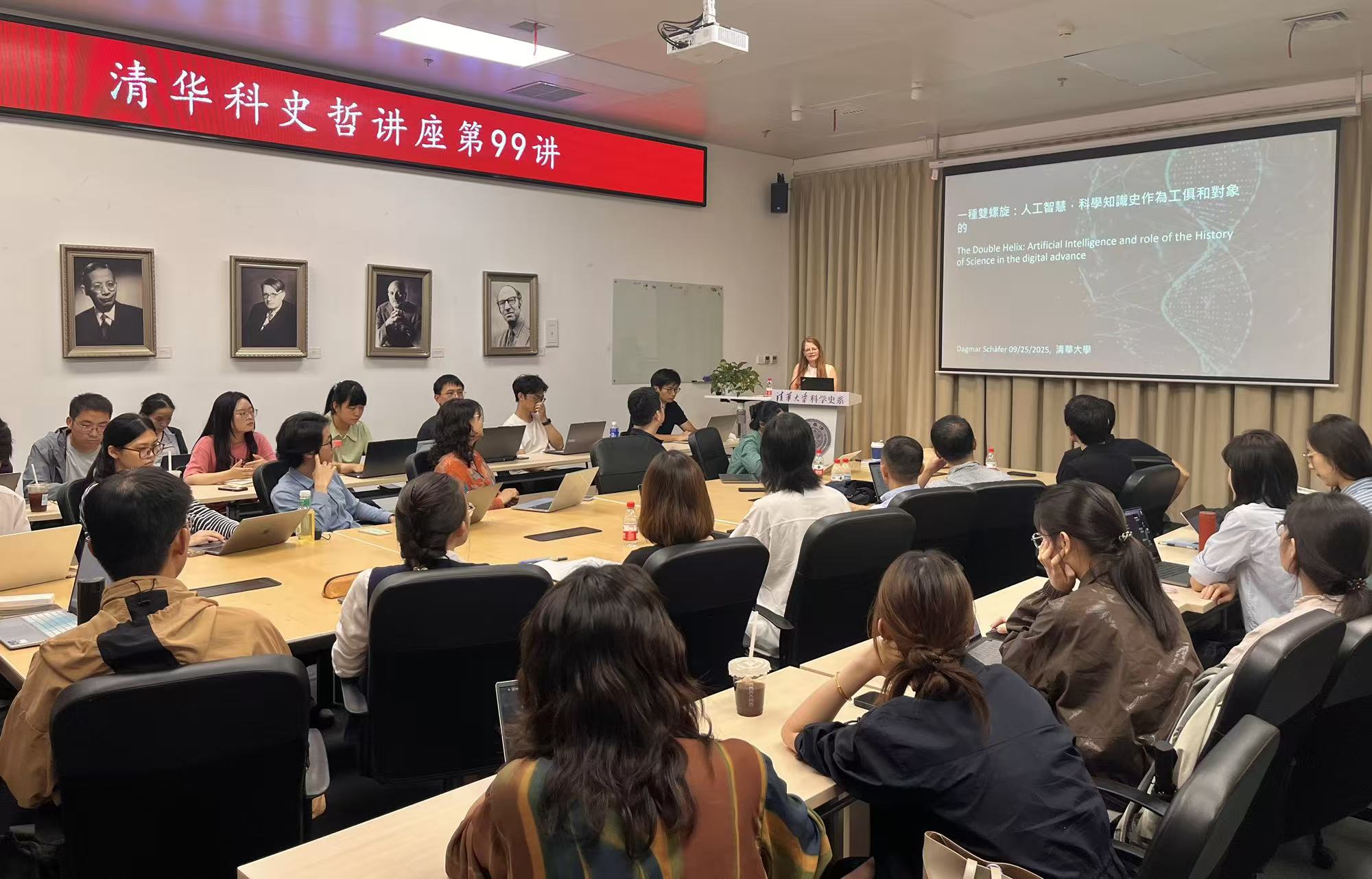
Finally, Professor Xue Feng also put forward some warnings and criticisms regarding the development of artificial intelligence. She believes that while artificial intelligence is good at processing large amounts of data, its weakness lies in its lack of abstraction and generalization abilities. People often mistakenly regard the computer's inability to forget as a sign of creativity or even intelligence. However, in Professor Xue Feng's view, it is precisely forgetting that leads to true creativity. Furthermore, intelligence requires social cognition. The future development of artificial intelligence still needs to strive for social cognition.
In her comment, Associate Professor Xiang Jing carefully sorted out two threads in Professor Xue Feng's report: first, how humanities scholars view technological progress; second, how artificial intelligence promotes humanities research in three specific scenarios.
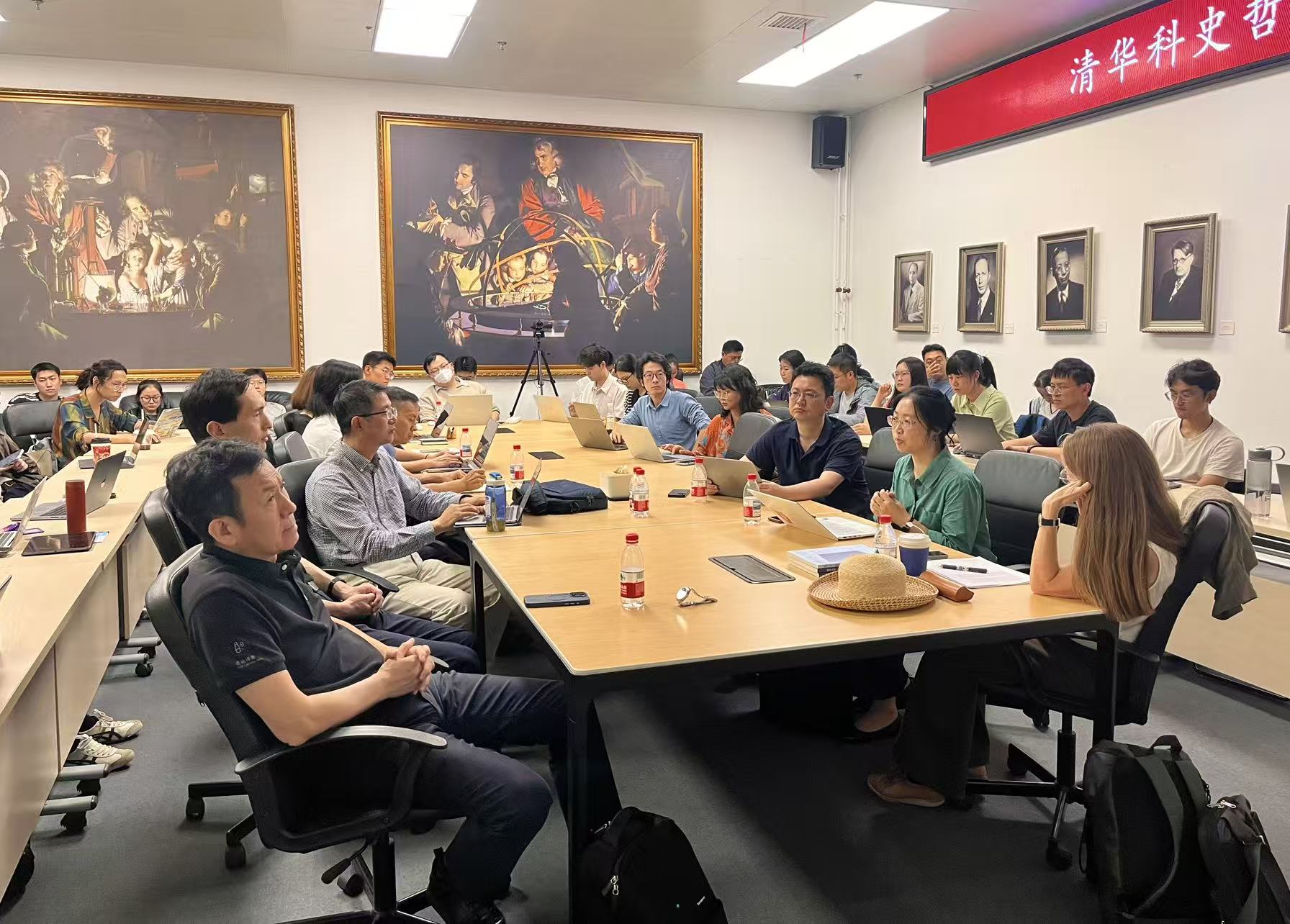
During the question and discussion session, teachers and students present asked Professor Xue Feng questions such as the relationship between artificial intelligence and the study of the history of science, the relationship between historical materials and data, how local knowledge in historical research can be transformed into common knowledge, and the impact of artificial intelligence technology on the profession of historians. Professor Xue Feng answered them one by one. This lecture concluded successfully amid lively discussions.
Written by: Lu Tianyang
Reviewed by: Shen Yubin