

On the afternoon of June 19, 2025, the Department of History of Science at Tsinghua University held the 96th Tsinghua Lecture on History and Philosophy of Science in the department hall of the Humanities Building. This lecture was hosted by Associate Professor Shen Yubin from the Department of History of Science at Tsinghua University. Professor Lena Springer from King's College London gave a report entitled "Removing Place Names from Traditional Chinese Medicine Archives".
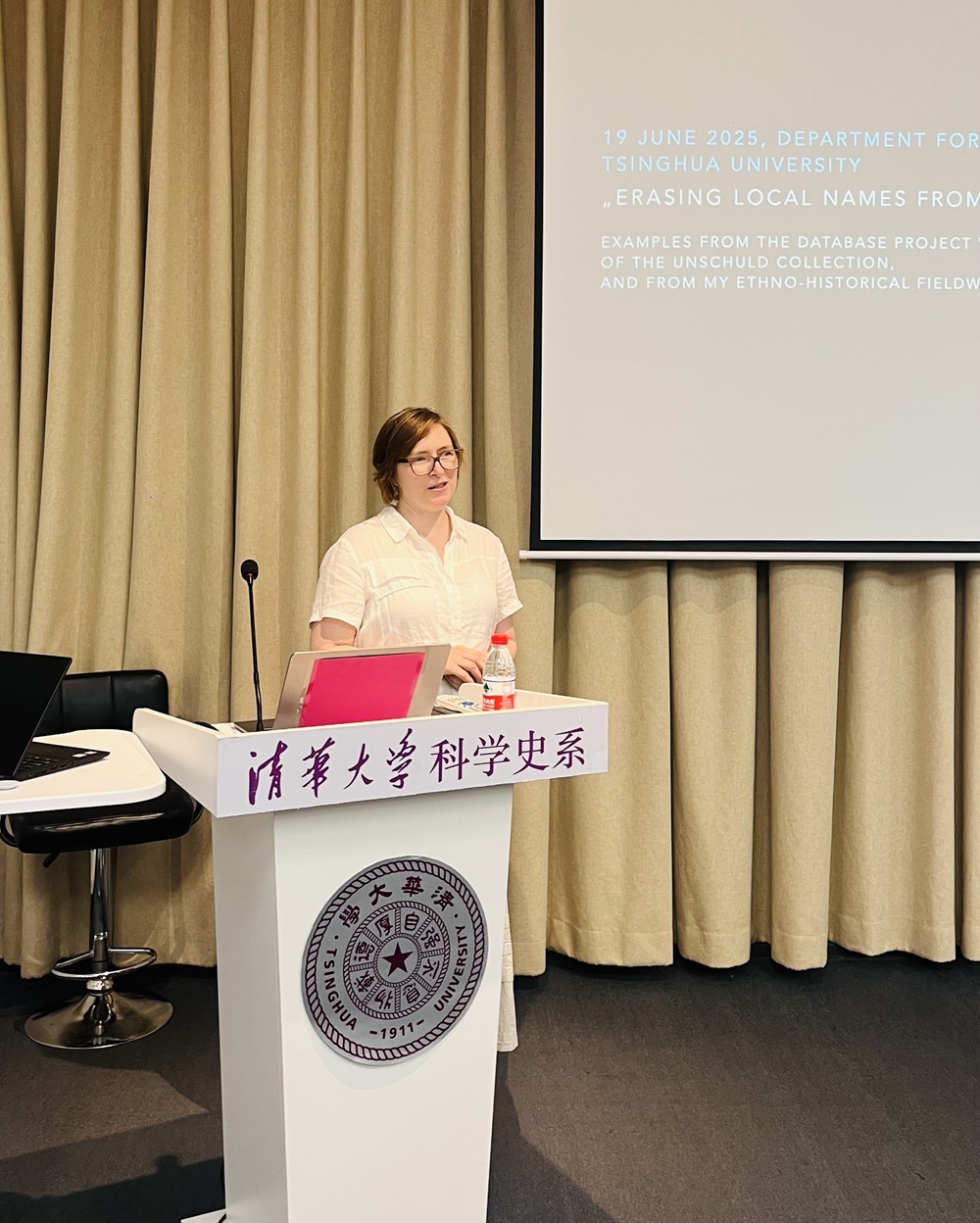
Teacher Lin Na first pointed out that names are crucial to Chinese materia medica. Experts from various backgrounds have been involved in the cause of classifying materia medica, yet they often adopt taxonomies that are incomprehensible to each other. Therefore, Springer attempts to find a method for the cause of scientific inquiry that eliminates local names while absorbing the local knowledge contained in these names. Lin Na noted that when using names, it is extremely important to reduce local name variations as much as possible, because names that cannot be understood in circulation are useless. To achieve this goal, scientific taxonomy is the most powerful tool, as it establishes and updates recognized names for things. In the history of Chinese materia medica, taxonomy is also a very mature academic field, and its encounter with botany and genetics is bringing about tremendous changes to it. Although botanical names are the only recognized scientific names, pharmaceutical names remain a mess to this day, whether in historical or ethnographic contexts, or in the most well-established regulations of pharmaceutical science. Different local experts and different professions adopt naming standards that are incomprehensible to each other.
As a case in point, Professor Lin Na demonstrated the medicinal herb "Chuanbeimu" (Fritillaria cirrhosa) that she encountered during her ethnographic research in the Taibai Mountain area. She emphasized that medicinal herb names with regional prefixes like "Chuan" (referring to Sichuan) were very popular in many manuscripts and documents. However, "Chuan" only indicates that the trader came from Sichuan, and is not helpful in determining the place of origin, which is truly crucial for the scientific nature of pharmaceuticals. In fact, "Chuanbeimu" is produced in the Taibai Mountain area, far from Sichuan. Another local example is "Zhuzishen" (Panax japonicus), also known as "Niuziqi". It is said that there are 72 local medicinal herbs with the suffix "qi" in their names, and this suffix actually represents dosage information – one dose for seven days. Lin Na concluded that for ethno-pharmaceuticals, there may be multiple names recorded and integrated beyond their botanical names; in the contexts of different languages and disciplines, the names of drugs reveal their sources, regional origins, characteristics, and effects.
Next, Professor Lin Na presented two previous related works she had participated in. The first was a large-scale project called SimLeap, which aimed to identify and extract taste-active components from plants in massive historical copies of Chinese herbal texts through data mining, thereby providing inspiration for contemporary flavor scientists in searching for alternative materials for various flavors. The project mainly utilized 240 volumes of archives from the large database of Chinese folk medical manuscripts collected and built by Paul U. Unschuld, which had been digitized into 41,000 prescriptions. For this purpose, Chinese characters were first transliterated into Latin script, then botanical names were used as the lingua franca of SimLeap to bridge the diverse range of medicinal names, and finally, traditional Chinese medicine terms for flavors (such as the "five flavors") were matched to those used in modern flavor science. Professor Lin Na then introduced two strategies for developing new sweet medicinal beverages: the first strategy involved analyzing traditional Chinese medicinal materials described as sweet in the database, matching flavor descriptions, and searching for the most commonly used sweet medicines; the second strategy was more "Chinese-style," which, based on sweet components like licorice frequently used in traditional Chinese medicine, aimed to develop a beverage that is neither bitter nor fattening but full of medicinal effects. Herbal researchers discovered some medicines from the manuscripts, then asked a company in Shanghai to find the medicinal materials and send them to a flavor analysis company in northern Germany that knew nothing about traditional Chinese medicine. During this process, all local names related to herbal medicinal materials were eliminated. Lin Na emphasized that in order to confirm the medicines and their natural sources, it is crucial to take into account different users and different data integration processes. Only in this way can local names be eliminated to achieve translocal understanding.
The second case of Professor Lin Na is her ethno-historical fieldwork in the Taibai Mountain area. Here, the boundary between Taoist physicians and herb-like physicians is blurred, and even the same person can have multiple identities, using terms such as "traditional Chinese medicine", "herbal medicine", and "Taoist medicine" interchangeably depending on the specific context. Lin Na emphasizes that the difference between, say, "traditional Chinese medicine" and "herbal medicine" does not lie at the material level, but in the different names adopted by different users. She found that in the current regulation of Chinese medicinal materials, information such as traders, production date and validity period, local origin, and registration number is marked on the drug labels, but information about the natural origin and the identity of the producers (medicinal herb farmers) is missing. Therefore, she hopes to trace this information through fieldwork. Lin Na introduced Zhu Mingsheng, an important pharmacist-Taoist physician in the Taibai Mountain area, pointing out that his pharmacy includes a large number of local medicinal materials not included in TCM, and relies on a complex supply network composed of more than 30 suppliers. In addition, traditional Chinese medicine has complex martial arts and religious connotations for Zhu Mingsheng. Lin Na also visited Cao Gongyi, an important supplier of Zhu Mingsheng. Cao Gongyi produces herbal medicines and teaches drug processing techniques at the university, and he is accustomed to comparing (what he considers) botanical names with drug names. Through the case of the herbal medicine "Guijianyu" (ghost-avoiding feather), Professor Lin Na pointed out that there is often a lack of a shared language for mutual understanding between botanists, local hospitals, and local suppliers. Finally, she reaffirmed that although cross-regional names are important, there is an urgent need to strengthen research on local herbal medicine, because these historical records are still very fragmented and weak - even cross-regional names are always faced with continuously updated historical records, which are either scientific or ethno-historical.
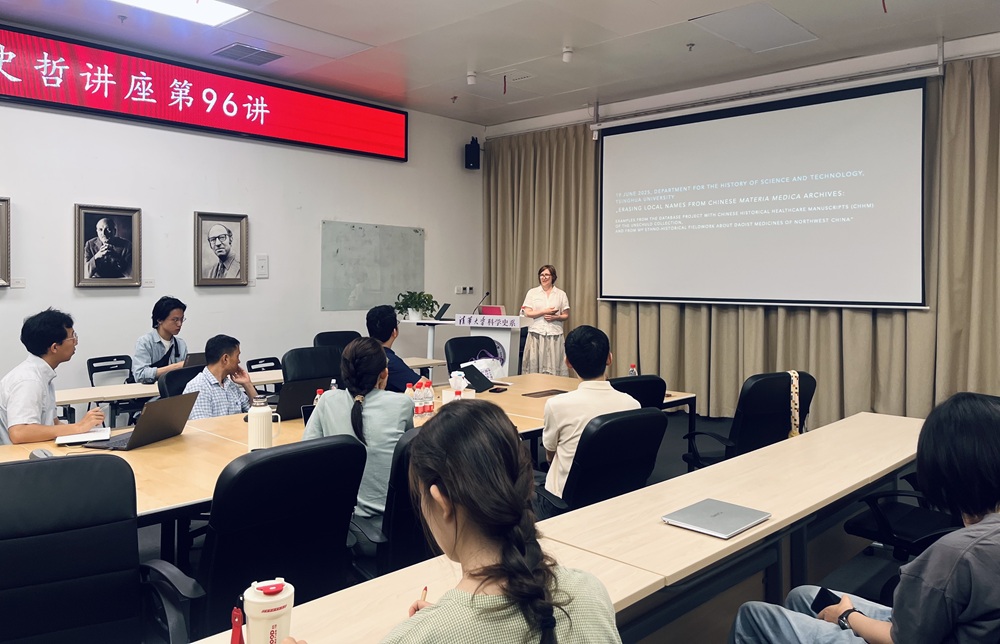
Subsequently, the teachers and students present raised questions to Professor Lin Na and engaged in lively discussions on issues such as the handling of plant names with unidentifiable species in the manuscripts, the differences in herbal varieties between those documented in literature and those sold in local markets, whether the SimLeap database will be open to access, and whether grassroots herbalists were once included in the barefoot doctor system.
Written by: Zhang Xiulin
Reviewed by: Shen Yubin