

On the afternoon of June 6, 2025, the Department of History of Science at Tsinghua University held the 94th Lecture on History, Philosophy and Science in Room 315 of the Humanities Building. This lecture invited Professor Mei Xueqin from the Department of History at Tsinghua University, with the theme "From Focusing on Issues to Contemplating Nature — The Mental Journey of Environmental History Research". The lecture was hosted by Mr. Shen Yubin from the Department of History of Science.
Professor Shen first introduced the academic experience and main research achievements of the speaker. Professor Mei has long been committed to the teaching, research, and talent cultivation in environmental history, British history, modern and contemporary world history, and green public history, significantly promoting the development of the discipline of environmental history in China.
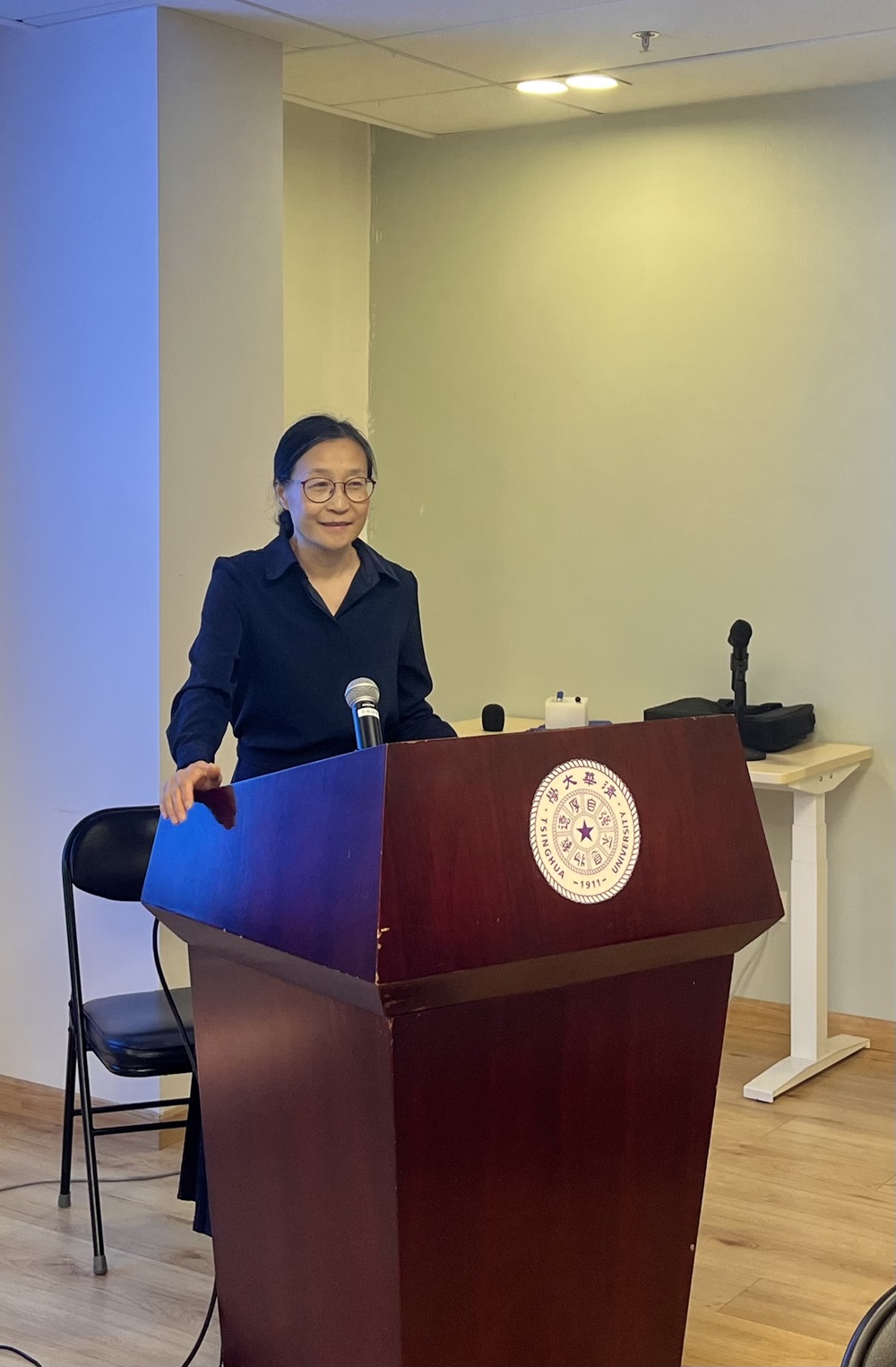
First, Professor Mei reviewed her research experience in environmental history, dividing her research journey into two phases. The first phase was the initial stage of research (1998 - 2004). Due to her focus on practical issues of environmental pollution and her participation in activities of the American Society for Environmental History during her visiting study in the United States, Professor Mei felt the charm of environmental history as a new expansion in the field of history. Therefore, she established environmental history as her research direction. After returning to China, she carried out environmental history research based on her foundation in British history studies, successively published a series of research papers, and edited the translation series *Ecology and Humans*. The second phase is the stage of expansion and sublimation of environmental history research (since 2004). Professor Mei expanded the scope of environmental history research from Britain to other regions of the world. Starting from 2007, she offered the course *Introduction to Environmental History Studies*, cultivating environmental history talents in China and promoting international exchanges in the discipline of environmental history. Meanwhile, in academic research, she reflected on the research perspectives and future development directions of the environmental history discipline, edited the series *Explorations in Environmental History*, and presided over the major national social science project *Environmental History and Its Innovation to Historiography*. Professor Mei believes that in the second phase, the main change was in the understanding of environmental issues themselves - from thinking that "industrialization and urbanization have caused environmental problems" to realizing that "environmental problems themselves are a manifestation of the rise and fall of life". She summarized her research experience as a process from focusing on problems to pondering the meaning of nature, which is precisely a process of understanding environmental issues and environmental history from the shallow to the deep and from the surface to the essence.
After that, Professor Mei accurately defined the concept of "environmental history". Environmental history is not equivalent to the contemporary history of addressing environmental issues; its overall framework is the history of the relationship between human society and the natural world. The research units and approaches of environmental history form a multi-dimensional framework, but they all ultimately need to focus on the connections between humans and nature. Currently, research on environmental history is conducted from both the perspective of humans and that of nature. The scope of environmental history research is becoming increasingly broad, with some scholars regarding the entire universe as the overall object of study in environmental history. Professor Mei summarized the innovative spirit of environmental history, which is to integrate human society with natural history on the basis of political history and social history, engaging in "exploring both upwards and downwards".
Following this, Professor Mei elaborated on the six transformative changes in the concept of environmental history after the idea of "integrating nature into history": (1) Transformation in the view of historical themes: "Choosing nature as the theme". Currently, in the selection of research topics, environmental history more often approaches from a natural perspective, delving into the changing relationship between humans and the natural environment. (2) Transformation in historical methodology: "Learning from nature as a teacher". Here, nature refers to living and non-living things other than humans. Therefore, in addition to personal observations and experiences, the assistance of environmental scientists is required, among which the basic concepts provided by ecology are the most fundamental. At this point, Professor Mei recommended two textbooks by Odum: *Fundamentals of Ecology* and *Ecology: A Bridge Between Science and Society*. (3) Transformation in the concept of historical dynamics: "Measuring the power of nature". Research in environmental history has shown that great importance should be attached to the power of nature behind history, which can be either a driving force or a resistance. Therefore, historical researchers need to understand the historical creativity of nature itself and analyze the role of nature in human survival and development, which is also the innovation of environmental history in the overall concept of historical dynamics. For example, in British history, it is impossible to present the related human history without mentioning the history of the River Thames. The River Thames is closely related to the formation and development of London, playing a pivotal role throughout. (4) Transformation in historical evaluation: "Using nature as a mirror". When evaluating history, environmental historians establish new historical evaluation criteria, analyzing the gains and losses of human society based on natural changes. Professor Mei proposed the "ecology-productivity criterion", using the service capacity of ecosystems as an indicator to record gains and losses. On this basis, Professor Mei pointed out that excellent environmental historians also need to be able to tell stories to enhance the readability of their works. (5) Transformation in the view of historical functions: "Speaking for nature". As a historical mirror, environmental history has the function of providing reference for governance and can offer channels for reflecting on nature conservation policies. (6) Innovation in the role of history: "Restoring the charm of nature". Research works by environmental historians on nature and naturalists can help people understand the beauty of nature in history and reflect on the "disenchantment of nature".
Finally, Professor Mei summarized his thoughts on the ontology of environmental history. In terms of the ontology of history, environmental history is a kind of Root History. Nature is not an "other" but a part of the grand history, and environmental history is an interdisciplinary existence. Environmental history makes history a basic discipline in a brand-new sense and a backbone of the new liberal arts. Therefore, Professor Mei created the concept of green public history and established the Research Center for Green World Public History at the School of Humanities, Tsinghua University, aiming to implement the concept of environmental history in talent cultivation and civic environmental education. In the future, environmental history should play a greater role in building a beautiful China.
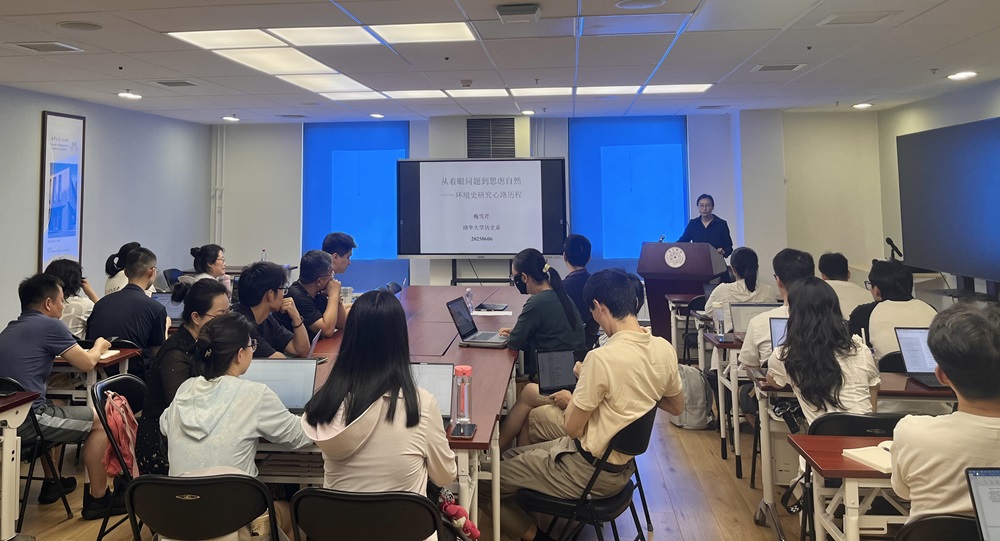
After the lecture, Professor Mei had an active interactive exchange with the teachers and students present. The questions included: inquiries about Professor Mei's research motivation in environmental history and details of his early research experience, the method of using natural science concepts in environmental history, the possibility of using digital historiography methods in environmental history in the future, and the differences in historicity between environmental history and Marxist philosophy, etc. A total of nearly 50 people from multiple schools and departments across the country, mainly teachers and students from the Department of History of Science, attended the lecture.
Written by: He Xiao'ao
Reviewed by: Shen Yubin