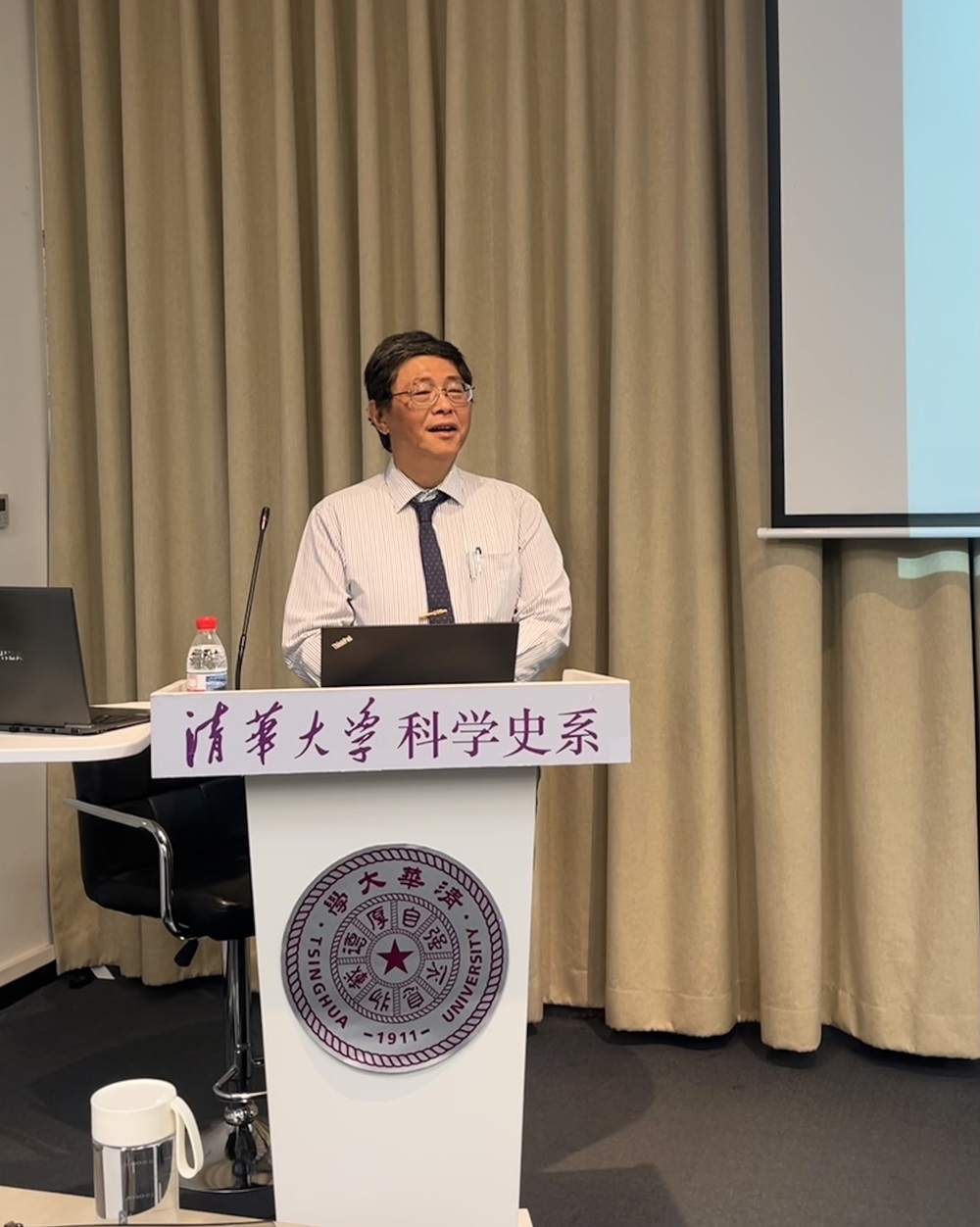

In the afternoon of May 29, 2025, the 92nd Tsinghua Lecture on History and Philosophy of Science was held in Room B206 of the Humanities Building. This lecture invited Professor Pan Guangzhe, a researcher at the Institute of Modern History, Academia Sinica, as the speaker. The theme of the lecture was "How to Welcome 'Mr. Science': Hu Shi and Pasteur", which focused on Hu Shi's interpretation of the French scientist Louis Pasteur (1822—1895) in modern China and explored the historical fate of "Mr. Science" in China. The lecture was hosted by Associate Professor Shen Yubin from the Department of History of Science, Tsinghua University.
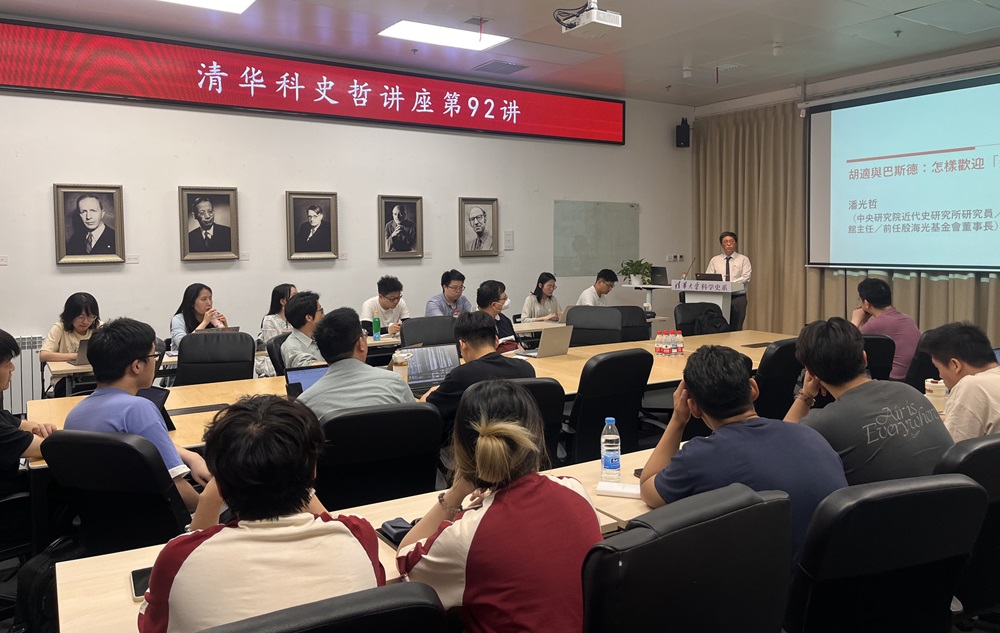
As the former chairman of the Yin Haiguang Foundation, Professor Pan Guangzhe briefly reviewed the academic careers of Tsinghua alumni Yin Haiguang and Zhu Kezhen, as well as scholars of the same era such as Zhang Yinlin and Zhang Qiyun, and introduced the theme of the lecture.
Professor Pan pointed out that the academic community currently has insufficient research on Hu Shi's practical work in promoting "Mr. Sai" (Science). During his tenure as the secretary of the China Foundation for the Promotion of Education and Culture (CFPEC) and in his subsequent work, Hu Shi made significant contributions to the institutional development of modern science and academic research. His experience of modern life and keen awareness of the world pattern made him pay attention to the phenomenon of science worship in China since the Reform and Opening-up Movement. Professor Pan believes that Hu Shi's reference to Pasteur as a "scientific hero" not only made science a part of citizens' epistemological qualities but also contained multiple dimensions. Using Quentin Skinner's research method in the history of ideas, Professor Pan placed Hu Shi's research on Pasteur in the context of modern Chinese thought and conducted multi-faceted interpretation and understanding of it.
Regarding the dissemination of Pasteur's image in modern China, Professor Pan mentioned reports in the *Shaoxing Journal of Medicine* in 1909 and *Eastern Miscellany* in 1922, and successively listed the citations and research on Pasteur by figures such as Yun Daiying (1895—1931), Sun Yat-sen (1866—1925), Liu Xian (1901—1987), and Bing Zhi (1886—1965).
Regarding Hu Shi's interpretation of Pasteur, Professor Pan discovered the 1923 edition of *The Life of Pasteur* with Hu Shi's handwritten annotations in the Peking University Library, providing new ideological resources for Hu Shi studies. When reading this book, Hu Shi couldn't help but shed tears as he thought of his beloved daughter Su Fei, who had passed away at an early age. Later, he elaborated on the exemplary significance of Pasteur from multiple perspectives. Firstly, Pasteur could serve as one of the "theoretical ammunitions" for Hu Shi in cultural debates. Hu Shi refuted Liang Shuming's cultural dualism of "Eastern spiritual civilization versus Western material civilization." He believed that Western civilization represented by Pasteur, by leveraging scientific power to safeguard human life and improve public health, contained profound humanistic care, and its "spirituality" was no less than that of civilizations which merely remained in speculation while neglecting real-world well-being. In addition, Hu Shi extended the exemplary significance of Pasteur to practical aspects. Faced with student movements in the first half of the 20th century, Hu Shi took Pasteur's spirit of concentrating on scientific research even in times of national crisis as a model, establishing Pasteur as a paragon of sound individualism. He exhorted young people that "one can serve others only after cultivating oneself" and "one can save the nation only after pursuing learning," advocating that young people's efforts to develop their personal knowledge and abilities were the true path to national salvation. Hu Shi's admiration for Pasteur was also reflected in his defense of academic independence in the face of political pressure during his later years as the president of the "Academia Sinica." In 1958, when Chiang Kai-shek demanded that the academic research of the "Academia Sinica" align with his political mission, Hu Shi refuted this by citing Pasteur as an example, arguing that academic prosperity was rooted in independence and free exploration rather than government directives.