

On the afternoon of May 8, 2025, the Department of History of Science at Tsinghua University held the 90th Tsinghua Lecture on History and Philosophy of Science in the department hall of the Department of History of Science in the Humanities Building. This lecture was hosted by Professor Wang Wei from the Department of History of Science at Tsinghua University. Professor Somogy Varga from Aarhus University in Denmark gave a report entitled "Rethinking the Concepts of Health and Disease".
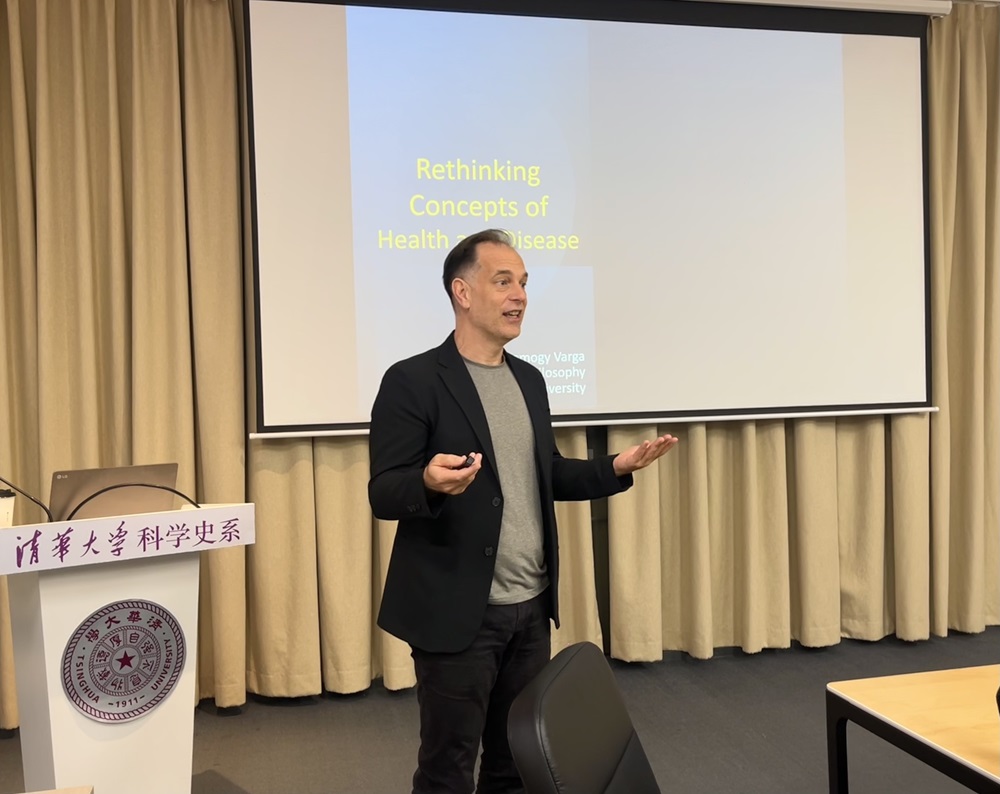
In this lecture, Professor Varga systematically explored the two core issues in the field of philosophy of medicine (the evaluative question and the relational question) around the essential definition of "health" and "disease" and their practical impacts. Based on the limitations of traditional conceptual analysis, he proposed the theoretical value and practical significance of the emerging research model of "experimental philosophy of medicine". On this basis, he demonstrated through three practical cases how to conduct empirical/experimental research in the philosophy of medicine. These cases and other similar studies are included in the upcoming new book published by Cambridge University Press, *Health and Disease: Experimental Philosophy of Medicine* (Health and Disease: Experimental Philosophy of Medicine). As one of the editors, Professor Varga integrated these interdisciplinary achievements, providing a methodological framework and a case library for subsequent research.
At the beginning of the lecture, Professor Varga raised the main question in the philosophy of medicine: What are health and disease? This question is closely related to the formulation of public health policies, clinical medical decision-making, and even society's perception of individual responsibilities. If we identify a certain condition (such as hypertension or depression) as a "disease", it will not only change the logic of medical resource allocation but also may reshape society's responsibility mechanism for related groups.
To understand the root cause of this impact, Professor Varga pointed out that we need to further consider two core questions: The first is the "evaluative question", that is, whether the concepts of health and disease are evaluative or descriptive? The former implies value judgments derived from social construction, while the latter reflects a value-free objectivity and neutrality. The second is the "relational question", that is, how health and disease are related to each other. Is health merely the absence of disease, or does it include more other presences? Does this ontological binary framework need to be reflected upon?
Professor Varga pointed out that traditional philosophical research relies on conceptual analysis, but this research path seems to have reached a dead end, especially as philosophers find it difficult to reach a consensus on the definition of disease (Schwartz, 2017). In response to this, some people have proposed an experimental turn, hoping to supplement traditional conceptual analysis with empirical methods, a path known as "experimental philosophy" (e.g., Hens and De Block 2023).
Professor Varga further introduced the goals and methods of experimental philosophy of medicine. He directly borrowed scenario design from experimental psychology, usually presenting participants with a scenario and asking them to judge whether the scenario involves a disease or which scenario is healthier. At the same time, some manipulable independent variables are set to observe their impact on dependent variables. By supplementing conceptual analysis with empirical methods (such as scenario-based controlled experiments), and observing how participants unconsciously apply concepts in specific scenarios, we can reveal whether their underlying cognitive frameworks are value-laden. Different from traditional sociology and psychology that directly ask for definitions in questionnaires, here participants are no longer simply invited to describe their own concepts of health but are required to deploy their concepts in these controlled and experimental scenarios.
Of course, this research method has faced doubts from traditional philosophy of medicine and beyond: Why should philosophy pay attention to the intuitions of laypeople? First, by resorting to collective judgment data on cases, we can revise conceptual analysis that over-relies on intuition, ensuring that theoretical construction is in line with daily language practices and social reality. Otherwise, if it deviates too far from common usage, we will not be able to talk about human health. Beyond philosophy, the concepts of health and disease among ordinary people revealed by this method are very important for both public health and clinical medicine.
Next, Professor Varga shared three research cases in turn. The first is "Evil and Disease". This study concerns whether evaluative judgments (such as moral character) about a person under certain conditions will affect the judgment of whether the condition is the person's health or disease. If so, whether such evaluations of a person's goodness or badness make it more or less likely to regard the condition as "health" or "disease", thereby proposing a possible connection between evaluative judgments and the concept of disease. This possible connection involves two hypotheses: The first is the "blame impulse". In a classic study (Knobe, 2004), it was found that if the outcome of an action is bad, people are more likely to think that the person who caused the outcome did it intentionally; while if the same action has a good outcome, people are less likely to think it was intentional. Based on this, Professor Varga proposed a "naturalization hypothesis": If people make negative judgments about P from the perspective of character or choice, they are less likely to label the individual's condition as a disease. The second is the "just world theory", which hopes to explore whether the deployment of the concepts of health and disease may involve a form of "belief in a just world", that is, the world is essentially fair, and "people get what they deserve". Based on this, Professor Varga proposed the "pathologization hypothesis": If people make negative judgments about someone based on their character or choices, they are more likely to label that individual with a disease. Then, through 500 participants reading fictional scenarios with different moral evaluations, the study tested which of the above two hypotheses is more consistent with reality. Professor Varga designed two versions of the story: the protagonist Alex was portrayed as a "bad person" (a corporate CEO who ignored environmental damage caused by production) and a "good person" (a CEO of a non-profit organization who was enthusiastic about public welfare), but both showed the same anxiety symptoms. The experiment strictly controlled other variables and only manipulated the moral attributes of the characters, aiming to observe whether moral evaluations affect participants' judgment on whether the same psychological state (anxiety) belongs to a disease. The experimental results were consistent with the "pathologization hypothesis", that is, people were more likely to consider the condition of the bad Alex as a disease than that of the good Alex.
Then, the second study further explored the impact of different moral evaluations on health judgments. It targeted the same group of people who participated in the previous study, but with a slightly smaller number. On this basis, Professor Varga verified three hypotheses: An individual's judgment on others' moral character not only affects disease judgments at the individual level but also extends to the overall health assessment of groups and even social subsystems; individuals with a noble moral image (moral saints) are generally considered healthier and less likely to get sick, and even if they get sick, it is considered unfortunate or that they do not deserve to get sick; when a biomedical mechanism explanation is provided for the disease, the impact of moral judgment on disease attribution will be weakened or even disappear.
The third study was to confirm the existence of the "reverse pathologization effect" by testing through a randomized controlled experiment (N=300) whether disease labels reversely affect judgments on an individual's moral character. Participants were divided into two groups: the disease group was told that the middle-aged man Alex was diagnosed with a fictional disease, while Alex in the healthy group had no health problems. Both groups described his daily behaviors (such as occasional dishonesty but not beyond the normal range), and then participants were asked to evaluate his moral image (such as sense of responsibility, degree of selfishness). The results showed no "reverse pathologization effect"</: Alex's disease/health status had no significant impact on his moral evaluation, and the disease label did not trigger more severe moral accusations.
Finally, Professor Varga summarized the content of this report, emphasizing the dual nature of the concepts of health and disease, namely descriptive and normative. Therefore, we need to understand the complex interaction between these two functions through the method of experimental philosophy.

Subsequently, the teachers and students present raised questions to Professor Varga and engaged in a lively discussion on issues such as whether the non-medical professional backgrounds of the participants in the research sample were divorced from the group of doctors who usually actually diagnose diseases, the rationality of the virtual or actual pathological settings in the research, the extent to which participants accept the premise of the "pathologizing assumption" itself — the "just world theory" and the actual cases of "reverse pathologizing effect", whether the experimental philosophy method is better than the traditional conceptual analysis method, how to define the boundary between disease and health, and how to understand concepts such as "sub-health".
Written by: Xu Jun
Reviewed by: Wang Wei