

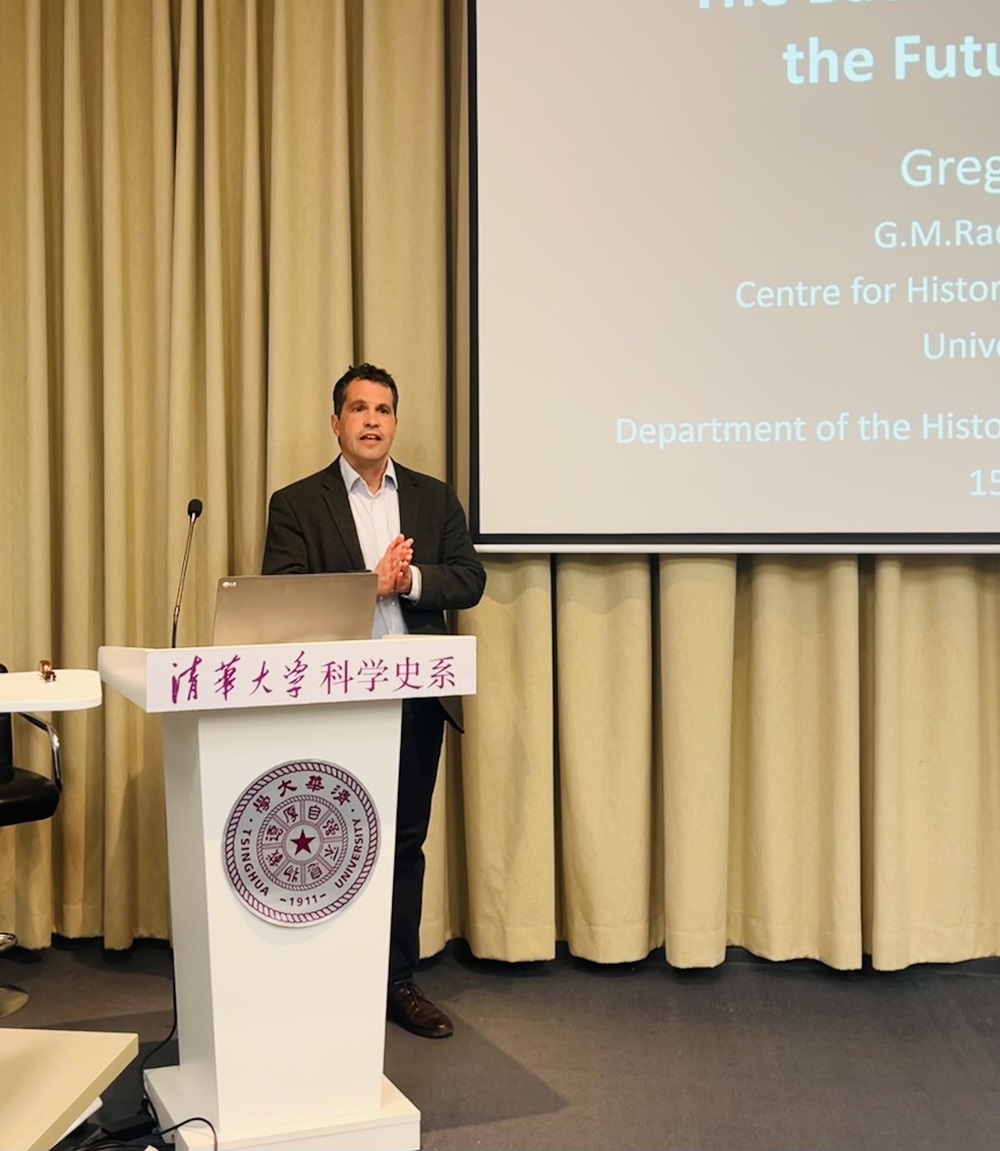
On April 25, 2025, the 89th lecture of the Tsinghua History and Philosophy of Science Lecture Series was held in Room B206 of the Humanities Building. This lecture featured Professor Gregory Radick from the School of Philosophy, Religion and History of Science at the University of Leeds as the keynote speaker. His lecture was titled "Contested Heredity: The Mendelian Controversy and the Future of Biology." The lecture was chaired by Professor Lu Yili from the Department of History of Science at Tsinghua University.
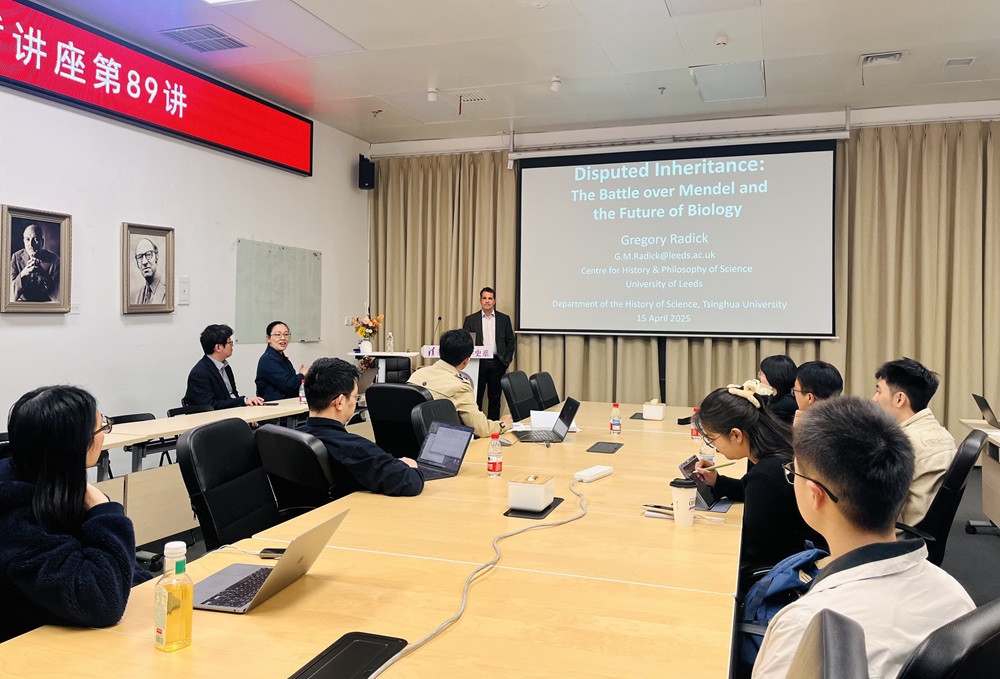
Professor Radick began by introducing two questions regarding Mendel's experiments: First, are all traits binary? Second, is the inheritance of traits always independent?
He then introduced the main figures of the Mendelian controversy: William Bateson (1861–1926), the founder of Mendelism in Britain, and Walter Frank Raphael Weldon (1860–1906), a British evolutionary biologist and biometrician. Both were Fellows of the Royal Society, and the controversy they led was a hot topic in the biological community during that period. It was not until Weldon's sudden death from acute pneumonia in 1906 that the controversy subsided. Radick primarily introduced us to Weldon's unpublished academic views. In Weldon's 1904 paper, he raised the following doubts about Mendel's experiments: "By carefully selecting cases of marriages between men and women with specific lineage backgrounds, we can almost certainly demonstrate that in their offspring, dark eyes exhibit dominant inheritance over light eyes, and vice versa. This law of inheritance may be as accurate for specific lineage families as Mendel's laws are for the peas he cultivated and other peas with similar genetic histories; however, if applied universally to all parents with dark and light eyes—that is, to mating individuals who happen to have specific eye colors in any lineage—the law will fail."
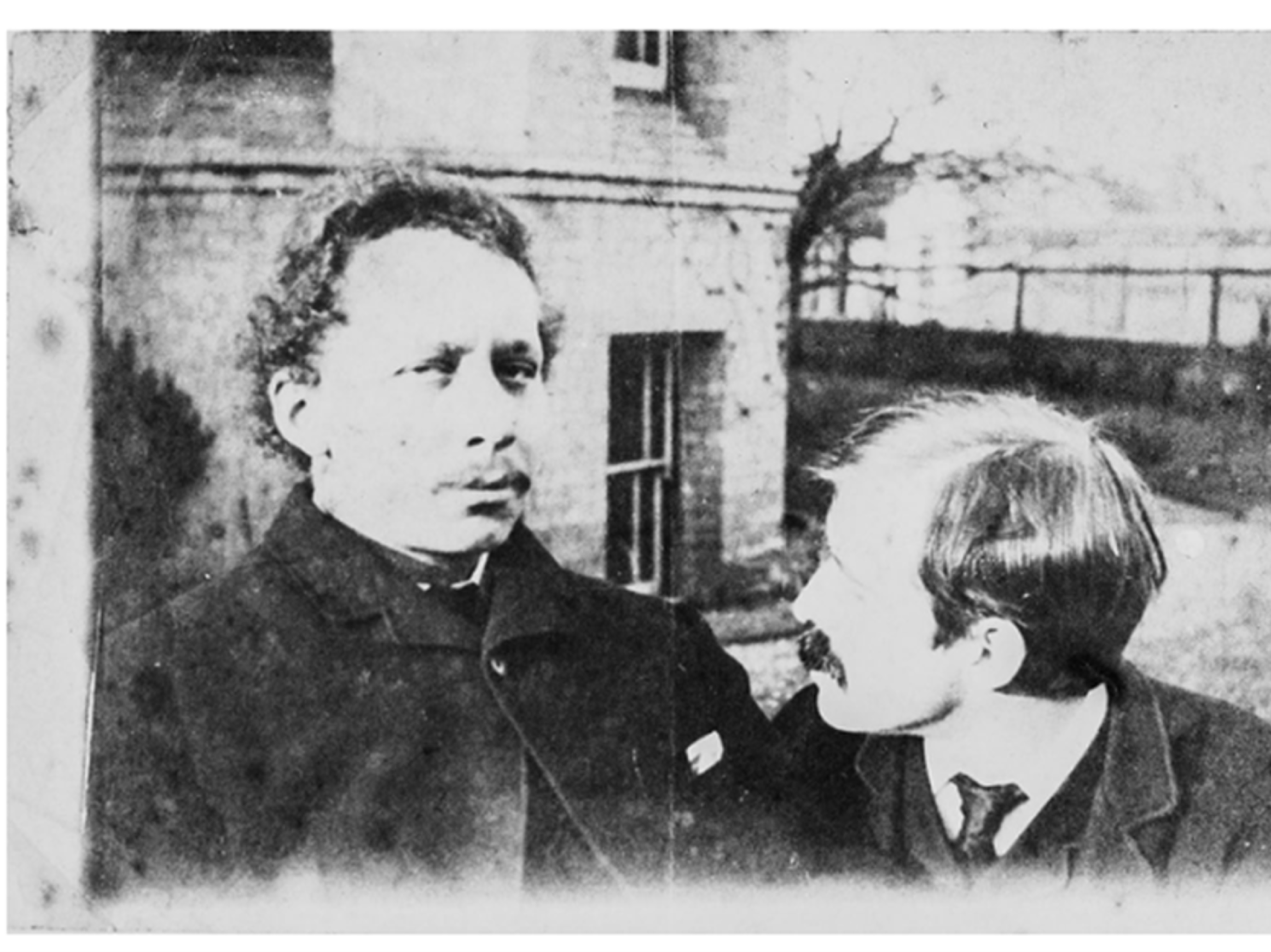
Figure 1. Photograph of Bateson and Weldon. Provided by Radick during the lecture.
In introducing Weldon's views, Radick pointed out that Weldon himself had also responded to the former of the two questions about Mendel's experiments mentioned at the beginning of the lecture—that is, whether all traits are binary. In Weldon's view, the traits exhibited by organisms are not strictly binary. In Weldon's 1902 research paper on *Daphnia*, he wrote: "Clearly, the developmental state of the carapace... is neither entirely acquired nor purely genetically determined. It belongs to both categories simultaneously. A *Daphnia* with a specific genetic background, if grown in a solution with specific chemical components, will exhibit a specific carapace length. From this, we can see that the trait characteristics of organisms are jointly determined by the interaction of environmental and genetic factors, and their mechanisms are extremely complex." Radick noted that there are many reasons why Weldon's theory was not adopted by textbooks and became mainstream. From a pedagogical perspective, Weldon's theory does not seem as concise as the conclusions of Mendel's experiments. Weldon's premature death prevented him from further promoting and perfecting his theory, among other factors.
As a contemporary researcher, Professor Radick explored the academic value of "counterfactual" reasoning—that is, exploring other possibilities in history by asking "what if history had taken a different course?" He emphasized that this type of research is not fictionalizing facts but rather evidence-based scholarly speculation aimed at reflecting on the contingency of scientific development. What is the purpose of counterfactual reasoning? Radick provided motivations from three aspects: genetics, science education, and cognitive science. Radick provided examples to illustrate each. From the perspective of genetics itself, Weldon's theory is more aligned with the views of modern geneticists and is particularly suitable for handling complex genetic phenomena. From the angle of science education, starting from Weldon's experiments can reduce students' misunderstandings about genetic determinism. At the cognitive science level, counterfactual research can stimulate rethinking of existing scientific paradigms. He cited Peter Bowler's 2013 book *Darwin Deleted: Imagining a World Without Darwin* (Chinese translation: *If There Were No Darwin: Scientific Speculation*, 2017) to further illustrate the significance of counterfactual reasoning in the field of history of science. Additionally, Professor Radick presented a comparison between Weldon's illustrations and those of modern geneticists (Figure 2), demonstrating Weldon's forward-looking perspective.
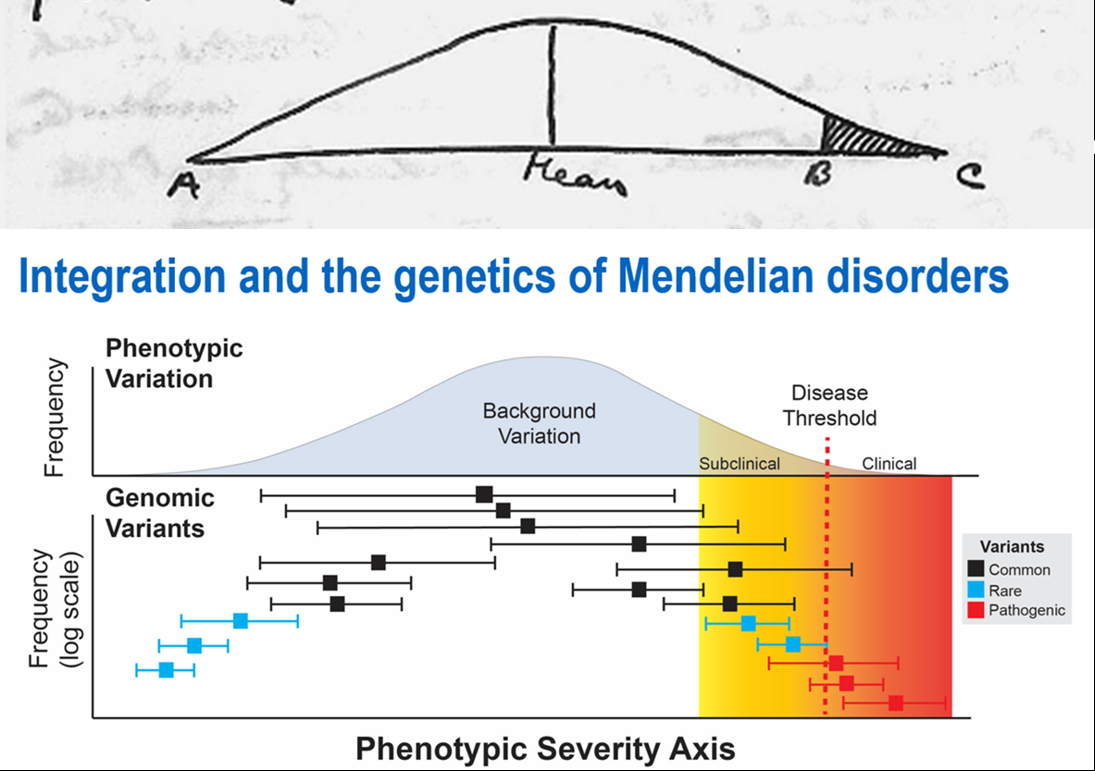
Figure 2. Illustration from Weldon's paper compared with illustrations from modern geneticists' papers. In Weldon's paper, he used this illustration to demonstrate that the binary classification of traits in Mendel's experiments roughly corresponds to the AB and BC segments in this diagram. In modern authors' papers, this illustration is used to demonstrate the complexity of biological genetics. Upon seeing the striking similarity in form between the two, Radick contacted the author of the modern paper and showed him Weldon's illustration from over a century ago. Radick described: "Weldon's illustration made him feel very surprised and delighted."
Following the lecture, Professor Lu Yili and other faculty and students in attendance engaged in a lively discussion with Professor Radick. Professor Lu Yili explored genetic pathways from the perspective of differences between continuity and discontinuity. Professor Radick responded that this classification of differences is a product of Mendelian historiography, and in reality, trait differences may not strictly follow the axis of continuity or discontinuity. Professor Jiang Che and Professor Huang Xiangfu from Nankai University inquired about the academic community's response to counterfactuals as a historical methodology. Professor Huang Xiangfu specifically mentioned that Professor Jon Agar from University College London had publicly denied the feasibility of counterfactual reasoning entering serious academic domains at the annual meeting of the British Society for the History of Science. Graduate students and visitors also exchanged views with the speaker from perspectives such as species evolution and British popular science.
Professor Radick recommended his English monograph to interested faculty and students and revealed that the Chinese translation of the book will be published by China Science and Technology Press in late 2025. He expressed gratitude to the Chinese translators and the publishing house.
Author: Luo Haotian
Reviewer: Lu Yili