

On April 11, 2025, the 88th lecture of the Tsinghua History and Philosophy of Science Lecture Series was held in Room B206 of the Humanities Building. This lecture featured Professor Cornelis J. Schilt from the Faculty of History at the University of Oxford as the keynote speaker. His lecture was titled "Isaac Newton's Chronological Studies: Connecting Past, Present, and Future." The lecture was chaired by Associate Professor Wang Zheran from the Department of History of Science at Tsinghua University. Professor Schilt's research focuses on the chronicles of ancient empires written by Newton himself.

Professor Schilt suggested that we can view Newton's legacy from multiple perspectives. Newton can be regarded both as an early modern scientist and as a scholar. Newton's scholarly knowledge extends far beyond physics and chemistry. As R. De Villamil noted in *Newton, The Man* (1931): "When studying Newton's reading list, what is most impressive at first glance is the large number of Greek and Latin classics it contains." Professor Cornelius first distinguished between chronological studies and historical research, arguing that chronology explains time itself and aids historical research, and the two should not be confused.
Newton's reading and writing practices provide clues for reinterpreting Newton's image. Newton's reading list includes a vast number of works, such as Ovid's *Metamorphoses* (a Latin epic from creation to Caesar), Hesiod's *Theogony*, Homer's *Iliad* and *Odyssey*, Herodotus's *Histories*, Thucydides's *History of the Peloponnesian War*, Virgil's *Aeneid*, Joseph Scaliger's *De emendatione temporum* (1608), which serves as a model for early modern chronological studies, James Ussher's *Annales veteris testamenti* (1650), and many others. Among the more than 2,000 books in Newton's reading list, over 200 are related to chronological studies.
During the lecture, Professor Schilt presented a map (graphia) related to the epic *Argonautica* and an image symbolizing monarchical states. When examining ancient history and cartography, Newton believed that mythological studies also help approach historical truth. Professor Cornelius's research on Newton focuses primarily on the chronicle works written by Newton (containing approximately 10,000 pages of content, including reused materials and folio manuscripts) as well as other manuscripts, such as *Theologiae Gentilis Origines Philosophicae* (1680s-mid-1690s, which can be compared with the "theory of the four ages of man" in Ovid's *Metamorphoses*), the essays "The Original of Religions" and "The Original of Monarchies" (1702–1706), as well as *Short Chronicle* (1717/1728) and *The Chronology of Ancient Kingdoms Amended* (1728). However, Newton's chronology also contains numerous controversies.
Professor Schilt stated that Newton's chronological research work enables us to determine the dating and sequence of his manuscripts. Professor Schilt also discussed Newton's methodological approach, noting that Newton used "scientific" methods to solve puzzles in chronology, attempting to incorporate all relevant ancient monarchical civilizations within a single temporal framework.
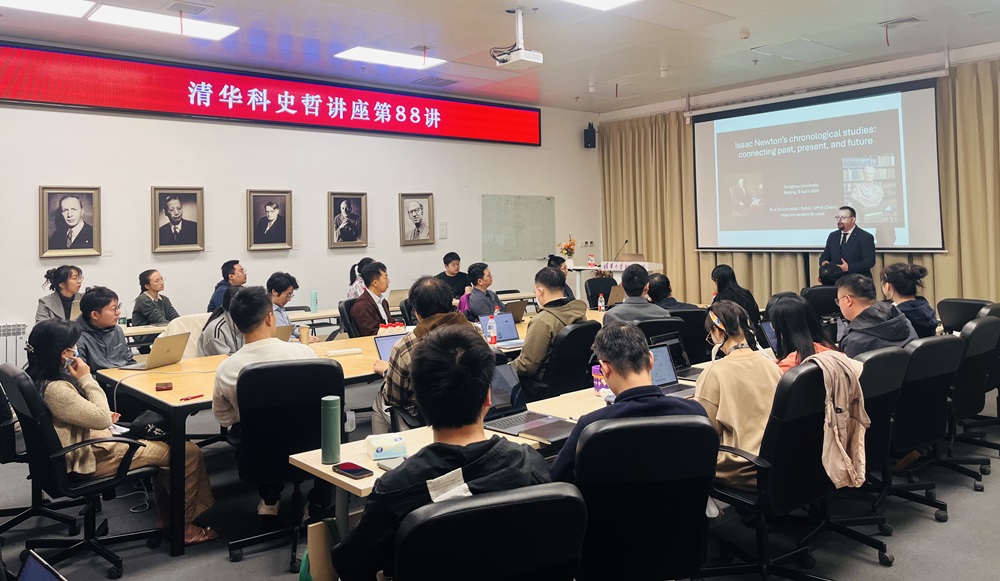
Following the main presentation, faculty and students in attendance actively raised questions. Professor Jiang Che noted that this lecture broadened the horizon of Newton studies and engaged in dialogue with the speaker on issues related to the history of reading and philology, asking whether Newton's manuscripts presented some systematic methodology similar to the commonplace books of Western manuscript copies from this period. Professor Schilt responded that, unlike Boyle and others, Newton's manuscripts appear quite disorganized in terms of textual compilation, and Newton's method of writing chronology was not adopted by subsequent historians after Newton.
Professor Lu Bolin asked how Newton's chronological studies mentioned the processes and roles of "nature." Professor Schilt explained how nature functions in the governance of empires by monarchs (especially through disease or aging), and how Newton believed that using an understanding of the natural lifespan of humans could test the reliability of data for chronological studies of dynastic transitions.
Some students also raised questions based on details from the lecture, engaging in highly inspiring exchanges with Professor Schilt. Professor Zhang Xiaotian asked: Newton established specific time frames for ancient mythology and ecclesiastical history verification—what was the deeper purpose behind his writing of these studies? Can this consideration of Newton's be compared with Bacon's "Great Instauration" plan? Professor Schilt pointed out that Newton's chronological studies reflect the tension between early modern science and religious issues. Newton was not providing historical evidence to support the Church, but rather believed that religion should return to its origins. Newton described this origin as Noah. In the early modern period, although Newton opposed Bacon on issues such as the methods of experimental philosophy, he shared with Bacon the belief that if humans could investigate nature in a reasonable manner and acquire natural knowledge, humans might once again regain this primordial knowledge. This would ultimately serve moral philosophy.
Finally, on behalf of the Department of History of Science, Professor Wu Guosheng expressed gratitude to Professor Schilt for his excellent lecture.
Author: Zhang Xiaotian